
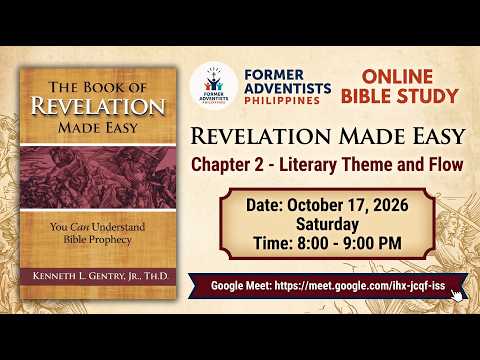
Former Adventists Philippines Prophecy Bible Study Guide
Revelation Made Easy: Chapter 2 - Literary Theme and Flow
(October 17, 2026, Saturday at 8:00 PM)
Prepared by: Bro. Ronald Obidos
Google Meet Link: https://meet.google.com/ihx-jcqf-iss
(October 17, 2026, Saturday at 8:00 PM)
Prepared by: Bro. Ronald Obidos
Google Meet Link: https://meet.google.com/ihx-jcqf-iss
(3 mins) | Opening Prayer
Leader's Guide: Begin with a relaxed, welcoming tone to help everyone settle in and leave behind any intimidating or fearful ideas they may have heard about the book of Revelation growing up.
Sample Prayer: "Heavenly Father, thank You for bringing us together today. As we open the book of Revelation, we ask the Holy Spirit to give us peace, wisdom, and clear eyes to see what You originally spoke to Your first-century church. Remove any fear or confusion, and help us see Jesus seated on His throne in victory and faithfulness. In Jesus' name, Amen."
(7 mins) | Icebreaker / Hook
Icebreaker Question: "Have you ever received a screenshot of a single text message without seeing the rest of the chat, or walked into a room right in the middle of a conversation, and completely misunderstood what was going on?"
Leader's Bridge to the Lesson:
- When we read a letter or a book without paying attention to when it was written and how the author speaks, we can easily get the wrong idea
- The two biggest mistakes readers make in Revelation are overlooking John's clear statements about when these events would happen and missing his symbolic style of writing.
- If we ignore John's near-term time frame, we end up turning Revelation upside down, taking events John said were at the beginning of Christian history and pushing them to the very end.
(15 mins) | Core Text & Simplified Reading
Passage to Read Aloud (9 Verses Total): Revelation 1:1, 3, 7, 9 and Revelation 5:1–5.
"The Revelation of Jesus Christ, which God gave Him to show to His bond-servants, the things which must shortly take place... Blessed is he who reads and those who hear the words of the prophecy, and heed the things which are written in it; for the time is near... Behold, He is coming with the clouds, and every eye will see Him, even those who pierced Him; and all the tribes of the earth will mourn over Him. Even so. Amen... I, John, your brother and fellow partaker in the tribulation and kingdom and perseverance which are in Jesus, was on the island called Patmos, because of the word of God and the testimony of Jesus." (Rev. 1:1, 3, 7, 9)
"And I saw in the right hand of Him who sat on the throne a book written inside and on the back, sealed up with seven seals. And I saw a strong angel proclaiming with a loud voice, 'Who is worthy to open the book and to break its seals?' ... and one of the elders said to me, 'Stop weeping; behold, the Lion that is from the tribe of Judah, the Root of David, has overcome so as to open the book and its seven seals.'" (Rev. 5:1–2, 5)
Q1: What is the main theme verse of Revelation, and what event is it actually describing?
A: John states his main theme right at the start in Revelation 1:7: "Behold, He is coming with the clouds, and every eye will see Him, even those who pierced Him; and all the tribes of the earth will mourn over Him."
A: While modern readers often assume at first glance that this verse describes the future, history-ending Second Coming of Christ, strong biblical and contextual evidence points in another direction.
A: Rather than the end of the world, Revelation 1:7 is a judgment prophecy against first-century Jerusalem, fulfilled when the Roman generals Vespasian and Titus destroyed the city and the Temple in A.D. 70.
Q2: How does the immediate context around Revelation 1:7 prove that John is talking about his own generation?
A: The golden rule of reading any document is "Context. Context. Context".
A: Before the theme verse: In verses 1 and 3, John insists that he is writing about "the things which must shortly take place" because "the time is near". It would make no sense for John to urge first-century Christians to read and obey his message because the time was near, only to give them a main theme that wouldn't happen for thousands of years.
A: After the theme verse: In verse 9, John reminds his readers that he is their brother and fellow partaker sitting in exile on Patmos during their grueling first-century persecution. God was promising near-term vindication for those suffering believers, not telling them He would avenge their pain millennia later.
Q3: How does the courtroom scene in Revelation 4–5 set up the flow of the whole book?
A: Revelation is structured like a courtroom drama, with the word "throne" showing up 47 times across 18 of its 22 chapters.
A: In chapter 4, God sits on His judicial throne surrounded by lightning and thunder. In chapter 5, He holds a legal scroll written front and back and sealed with seven seals, which Jesus (the Lion of Judah) steps forward to open so that judgment can be carried out.
(15 mins) | Interactive Discussion & "Interesting Ideas"
Q1: Symbolism Breakdown: If nobody saw Jesus physically floating down on a literal cloud in A.D. 70, why does John say, "He is coming with the clouds"?
A: In the Bible's apocalyptic style, God "coming on the clouds" is symbolic language for when He steps into history to bring judgment upon a nation.
A: For example, in Isaiah 19:1, the prophet warned that "the Lord is riding on a swift cloud, and is about to come to Egypt," a judgment fulfilled historically when the Assyrian king Esarhaddon conquered Egypt in 671 B.C., without anyone seeing God physically sitting on a cloud.
A: Jesus used this exact same language at His trial in Matthew 26:64, telling the Jewish high priest and those standing around him, "hereafter you shall see the Son of Man sitting at the right hand of Power, and coming on the clouds of heaven".
A: This also matches Jesus' Parable of the Vineyard Owner (Matt. 21:33–45) and the Wedding Feast (Matt. 22:7), where the Lord "comes" in judgment against the leaders who killed His Son by sending armies to destroy those murderers and burn their city in A.D. 70.
Q2: Word Study: Who are "those who pierced Him" and "all the tribes of the earth"?
A: "Those who pierced Him": Even though Roman soldiers physically nailed Jesus to the cross, the New Testament repeatedly places the covenantal blame on first-century Israel for demanding His death (Matt. 27:25; John 19:15; Acts 2:23; 5:30; 7:52; 1 Thess. 2:14–16). Because those specific people have been dead for over 1,900 years, this judgment had to fall in the first century while they were still alive.
A: "All the tribes of the earth": The Greek word translated "earth" (ge) is frequently translated as "land" throughout the New Testament, referring specifically to the Promised Land of Israel (e.g., Matt. 2:20–21; Acts 10:39). Furthermore, the Greek word for "tribe" (phulē) most often points to the twelve Jewish tribes living in that land.
A: Literal Bible translations actually read: "and wail over him shall all the tribes of the land", pointing directly to the mournful judgment of Jerusalem in A.D. 70 that Jesus warned about in Luke 19:41–44, Luke 21:20–24, and the Olivet Discourse in Matthew 24:30, 34.
Q3: Answering Popular Questions: What if someone brings up 2 Peter 3:8 ("one day is as a thousand years") or asks if "every eye" means the whole globe?
A: On "God's Timing" (2 Pet. 3:8): Peter is making a theological point about how God views time to answer mockers who claimed God's promises had failed; John, on the other hand, is giving urgent historical instructions to suffering Christians about what they were about to face shortly.
A: On "Every Eye Will See Him": In everyday biblical language, words like "all" and "every" often describe a major public event rather than literally every single person on the planet, just like Matthew 3:5 says "all Judea" went out to hear John the Baptist. Moreover, John immediately defines who "every eye" refers to in the next phrase: "even [that is] those who pierced Him".
Q4: Creative Comparison: The Courtroom Divorce & The Tale of Two Women
Leader's Analogy: Invite the group to picture Revelation 4–21 as a dramatic covenantal court case involving two women: an unfaithful wife (the Harlot) and a faithful new wife (the Bride).
The Marriage & The Betrayal: In the Old Testament, God was a Husband to Israel (Isa. 54:5; Jer. 31:31–32), so whenever Israel turned away from Him and shed innocent blood, the prophets called it spiritual adultery and harlotry (Jer. 3:9; 5:7; Eze. 23:37).
The Divorce Scroll: Because of first-century Jerusalem's spiritual harlotry (called "Babylon the Great, the Mother of Harlots" in Rev. 17:4–5), the seven-sealed scroll in God's hand (Rev. 5:1) functions as a legal certificate of divorce, echoing Jeremiah 3:8 and Ezekiel 2:9–3:1, while the seven seals, trumpets, and vials mirror the seven-fold covenant punishments of Leviticus 26.
The Execution by Stoning: Under Old Testament law, the capital punishment for adultery and harlotry was stoning (Lev. 20:10; Deut. 22:21), which is why Revelation 16:21 pictures Jerusalem's destruction with 100-pound hailstones crashing down from heaven.
The New Bride: Once the unfaithful harlot city is judged and the obsolete Old Covenant temple is removed in A.D. 70 (Heb. 8:13), a radiant new Bride steps onto the scene in Revelation 19:9 and 21:2, the "New Jerusalem" coming down from heaven, representing the Christian Church taking the place of the old system in God's redemptive plan (Gal. 4:25–26; Heb. 12:22; Matt. 21:43).
(12 mins) | Real-Life Application
Q1: Knowing how devastating the A.D. 70 fall of Jerusalem was, ending the Old Covenant temple and sacrifices forever, how does this strengthen our confidence in Jesus today?
A: History confirms that Jesus' warnings came true down to the smallest detail: as the Jewish historian Josephus and archaeologist Kathleen Kenyon recorded, Titus's Roman armies burned Jerusalem, tore the Temple stones apart, and permanently ended the Old Testament sacrificial system in A.D. 70.
A: Because Jesus' words were fulfilled within that exact first-century generation just as He promised (Matt. 24:34), we don't need to live in fear of sensational end-times news headlines; we can trust that God's Word is completely reliable and that Jesus reigns from His throne right now.
Q2: Since the Church is now the "New Jerusalem" and the Bride of Christ, how should that shape the way we live this week?
A: In the Old Covenant, worship was tied to a physical building and animal sacrifices in earthly Jerusalem, which grew obsolete and disappeared in A.D. 70 (Heb. 8:13).
A: In the New Covenant, we are the heavenly Jerusalem and the Bride prepared for her Husband (Heb. 12:22; Rev. 21:2). This week, instead of treating faith like a ritual tied to a physical place, we are called to guard our hearts against modern idols, stay faithful to Jesus in our daily walk, and actively bear the fruit of God's Kingdom wherever He has placed us (Matt. 21:43).
(5 mins) | Takeaways & Wrap-up
One-Sentence Summary: Revelation is not a fearful puzzle about the end of the planet, but a powerful courtroom drama showing how Jesus judged first-century Jerusalem in A.D. 70 to bring the obsolete Old Covenant to a close and establish the Christian Church as His glorious New Covenant Bride.
Teaser for Next Session: Keep these images of the Harlot and the siege of Jerusalem in mind. In our upcoming sessions, we will unpack the eye-opening details of how the Harlot's identity and the 100-pound hailstones of Revelation 16 matched the real historical siege of A.D. 70!
(3 mins) | Closing Prayer
Leader's Guide: Invite group members to briefly share any practical needs they are carrying this week (work stress, family concerns, health, or staying strong in their walk with God), then close in prayer.
Sample Prayer: "Lord Jesus, thank You that You are the faithful King who keeps every promise. Thank You for bringing us into the New Covenant as Your treasured Bride, the New Jerusalem. Help us walk through this week with unshakable peace, knowing You sit on the throne, and empower us to produce the good fruit of Your Kingdom in our homes and workplaces. We also lift up the practical needs shared in our group today, and ask that You meet each brother and sister with Your grace and provision. In Your mighty name we pray, Amen."




No comments:
Post a Comment