Showing posts with label prophecy. Show all posts

Wednesday, October 1, 2025

Daniel 2: Why It's not About the Second Coming of Christ?


One of my favorite Bible prophecies is found in Daniel 2. It’s the moment when the prophet Daniel explains King Nebuchadnezzar’s dream—a dream that wasn’t just bizarre but loaded with history and eternal significance.

The king saw a massive statue made of different metals:

  • A head of gold

  • A chest and arms of silver

  • A belly and thighs of bronze

  • Legs of iron, with feet partly of iron and partly of clay

Then, a stone “cut out without hands” came crashing down from heaven, smashed the statue’s feet, and reduced the whole thing to dust. The stone grew into a mountain that filled the entire earth.

What did it mean? Daniel explained that the metals represented successive kingdoms, beginning with Babylon (the head of gold). History confirms the sequence:

  1. Babylonian Empire

  2. Medo-Persian Empire (Daniel 5:28; 8:20)

  3. Greek Empire (Daniel 8:21)

  4. Roman Empire

And the stone? That was the key. Daniel declared:

“In the days of those kings, the God of the heavens will set up a kingdom that will never be destroyed…” (Daniel 2:44, CSB)

So, what is this stone? When does it arrive? And whose interpretation really fits Scripture? Let’s dig in.


The SDA Futurist Take

Seventh-day Adventists teach that the “stone” represents the Second Coming of Christ. Their official belief (see SDA 28 Fundamental Beliefs, p. 499) divides God’s kingdom into two stages:

  1. The Kingdom of Grace (now)

  2. The Kingdom of Glory (future, beginning at Christ’s return)

In their view, the stone hasn’t struck yet. We’re still waiting for it.


Why That Doesn’t Fit the Bible

The problem is simple: the Bible says Christ is already reigning. According to the Scripture, Jesus ascended to His Father, took His seat at the right hand, and began His reign 2,000 years ago. That was the “stone” striking the statue during the time of Rome, not Europe in the Middle Ages.

The Roman Empire was the fourth kingdom. The stone smashed it—not some vague future “ten-nation confederacy.”

Daniel 7 confirms it:

“One like a son of man was coming with the clouds of heaven… He was given dominion and glory and a kingdom…” (Daniel 7:13-14, CSB)

Notice the direction: Christ goes up to the Ancient of Days, not down to Earth. That’s His ascension, not His second coming.


But What About Other Empires?

Here’s where Adventism runs into a historical blind spot. They insist Rome was the final empire before Christ’s return. But history tells us otherwise.

  • The Ottoman Empire (1299–1923) dominated three continents for six centuries. It ruled the Middle East, North Africa, Arabia, and even Europe.

  • The Mongol Empire (1206–1368) was the largest land empire in history, dwarfing Rome in size.

If Daniel 2 was a prophecy about all empires in human history, why ignore these superpowers? The answer: because Daniel wasn’t writing about every empire ever. He was writing about the ones directly tied to Israel’s covenant history. That’s why the prophecy stops at Rome.


The Iron and Clay

Adventists like to stretch the “iron and clay” into modern Europe. But Daniel says otherwise:

“You saw the iron mixed with clay… it will be a divided kingdom.” (Daniel 2:41, CSB)

One kingdom, divided—not ten separate kingdoms. The clay element doesn’t symbolize Europe; it points back to Israel itself. The prophets often called Israel “clay” (Isaiah 64:8). So the iron/clay feet represent the Roman Empire intertwined with Israel during the first century—precisely the context of Christ’s ministry, crucifixion, and the destruction of Jerusalem in AD 70.


The Stone: Already Rolling

Here’s the big point: the stone is Christ’s kingdom, and it already began.

Peter preached at Pentecost:

“God has raised this Jesus… Therefore let all the house of Israel know… God has made this Jesus, whom you crucified, both Lord and Messiah.” (Acts 2:32-36, CSB)

Paul echoed:

“He has rescued us from the domain of darkness and transferred us into the kingdom of the Son he loves.” (Colossians 1:13, CSB)

Not “will transfer,” but has transferred. The kingdom is here, growing like a mustard seed (Matthew 13:31-32), spreading like leaven (Matthew 13:33), and destined to fill the earth (Daniel 2:35).


Why This Matters

If Christ is already reigning, we’re not waiting around for His “real” kingdom to arrive someday. We’re living in it now. Yes, evil still exists. Yes, the final enemy—death—will be destroyed at His return (1 Corinthians 15:24-28). But make no mistake: Jesus is already King.

Adventist futurism weakens the glory of Christ’s present reign by pushing it off into the future. But Scripture, church history, and the gospel itself declare otherwise: the stone has struck, the mountain is growing, and Jesus rules now.


Final Thought

Daniel 2 isn’t just about kingdoms of the past; it’s about the unstoppable kingdom of God in Christ. That kingdom isn’t waiting for Europe to collapse or for ten kings to rise. It started when Christ rose, ascended, and sat down at the right hand of God.

Our Adventist friends would do well to heed the advice of their own prophet, Ellen White:

"There is no excuse for anyone in taking the position that there is no more truth to be revealed, and that all our expositions of Scripture are without an error. The fact that certain doctrines have been held as truth for many years by our people, is not a proof that our ideas are infallible. Age will not make error into truth, and truth can afford to be fair. No true doctrine will lose anything by close investigation."(Ellen G. White, Counsels to Writers and Editors, p. 35) (Counsels to Writers and Editors, p. 35)

And when we investigate Daniel 2 closely, the truth is clear: Christ is King—already, now, and forever.


For more inquiries, contact us:

Email: formeradventist.ph@gmail.com

Website: formeradventistph.blogspot.com

Facebook: https://www.facebook.com/groups/formeradventistph

Phone: 09695143944


Sunday, September 14, 2025

Revelation 16:16 Explained: The Real Story Behind Armageddon!

From a Partial Preterist lens, “Armageddon” (Revelation 16:16) isn’t about tanks rolling into the Middle East in our future or some apocalyptic showdown in modern Israel. Instead, it’s read as a symbolic portrayal of God’s judgment on apostate Israel in the first century, climaxing in the destruction of Jerusalem in AD 70.

Here’s the breakdown:


1. The Symbolism of Armageddon

  • The name Har-Magedon literally means “mountain of Megiddo.” Problem: Megiddo isn’t a mountain—it’s a plain. This signals it’s not a literal geographic battlefield but an apocalyptic metaphor.

  • Megiddo in the OT was a place of decisive battles and bloody defeats (Judges 5:19, 2 Kings 23:29). So when John uses the term, it evokes the memory of Israel’s historic battle losses—a prophetic way of saying: “Here comes another catastrophic judgment.”


2. Connection to the Jewish War

  • The gathering at Armageddon (Rev. 16:13–16) parallels the Roman armies being stirred up against Jerusalem.

  • The “frogs” from the dragon, beast, and false prophet symbolize demonic deception, luring the nations into God’s judgment plan. Rome thought they were simply crushing a rebellion, but in God’s sovereignty, they were instruments of covenant wrath.


3. The Great Day of God

  • Rev. 16:14 calls it the “great day of God Almighty.” For Partial Preterists, this points to the day of the Lord against Israel—not the final end of the world, but the end of the Old Covenant world (cf. Matt. 24:29–34).

  • The fall of Jerusalem was the climactic covenant lawsuit: God gathered the nations (Rome and her allies) to execute judgment, just as the prophets often said (Joel 3:2, Zech. 12–14).


4. Victory in Christ, not Military

  • Importantly, Armageddon isn’t about Jesus swinging a sword against Gentile nations in our future. Instead, it’s Christ reigning in judgment through historical events.

  • The cross already won the decisive battle. AD 70 was Christ vindicating His people and ending the Old Covenant order, clearing the stage for the full expansion of the gospel to the nations.


So in short, Armageddon, from a Partial Preterist standpoint, is the symbolic depiction of Jerusalem’s downfall under Rome in AD 70—God’s covenantal judgment on apostate Israel, not a literal future world war.


Summary:

Partial Preterist View of Armageddon

  • Timing: First-century fulfillment, climaxing in AD 70 with the destruction of Jerusalem.

  • Meaning of “Armageddon”: Symbolic, not geographic. It points back to Megiddo, the OT site of bloody defeats, symbolizing God’s judgment on apostate Israel.

  • Who’s involved: Rome and her allies (the “nations”) used by God as covenantal instruments of judgment.

  • Focus: The end of the Old Covenant age, not the end of human history.

  • Result: Christ is vindicated, the church is preserved, and the gospel is unleashed to the nations.


Futurist (Dispensational) View of Armageddon

  • Timing: Still future—usually tied to the end of the church age or the “time of trouble.”

  • Meaning of “Armageddon”: A literal battle in the land of Israel (often the Jezreel Valley, near Mount Megiddo).

  • Who’s involved: Massive end-time world war. Nations of the earth gather against Israel in a literal military conflict.

  • Focus: A climactic physical battle on earth before Christ’s second coming.

  • Result: Jesus returns in person, slaughters the nations, sets up a millennial reign on earth (for Dispensationalists).


Key Differences

  1. Timeframe: Partial Preterists say it was already fulfilled in AD 70; Futurists push it into the future.

  2. Battlefield: Partial Preterists say symbolic battlefield of covenant judgment; Futurists say literal battlefield in Israel.

  3. Covenant Lens: Partial Preterists see it as the end of the Old Covenant world; Futurists see it as the end of the entire world order.

  4. Christ’s Role: Partial Preterists say Christ judged through Rome; Futurists say Christ will physically return with armies to wipe out nations.


In short, Partial Preterism keeps Armageddon tethered to the Bible’s covenantal story and the first-century crisis, while Futurism rips it out of its historical context and makes it a future war movie.


Chart: Armageddon: Preterist vs. Futurist Views

Category Partial Preterist View Futurist (Dispensational / SDA) View
Timing Fulfilled in the first century (AD 70, destruction of Jerusalem). Still future, usually tied to the “end of the world” or Great Tribulation.
Location Symbolic “mountain of Megiddo” (Rev. 16:16), a metaphor for covenant judgment. A literal battlefield in Israel (often the Jezreel Valley near Mount Megiddo).
Main Players Rome and allied nations as God’s instruments of wrath against apostate Israel. End-time world powers gathered against modern Israel.
Focus The end of the Old Covenant age; judgment on Jerusalem. The end of human history; climax of global rebellion.
Christ’s Role Christ reigns and judges through historical events (Rome’s conquest). Christ returns visibly with armies to destroy nations in battle.
Outcome Jerusalem falls, the Old Covenant is abolished, and the gospel expands to the nations. Nations destroyed, Jesus sets up an earthly millennium (Dispensational) or vindicates Sabbath-keepers (SDA spin).
Theological Lens Covenantal: prophetic fulfillment in AD 70, consistent with Matt. 24:34. Apocalyptic literalism: pushes the text into a future end-time scenario.

The short punchline:

  • Preterist Armageddon = AD 70, covenant judgment.

  • Futurist Armageddon = future world war, end of the age.


Answering Objections About Armageddon (Revelation 16:13–16)

Whenever we talk about the Partial Preterist understanding of Armageddon, objections come flying fast. And honestly, that’s a good thing. Wrestling with hard questions helps us sharpen our theology and anchor it in the Word. Let’s walk through some of the most common pushbacks, one by one.


Objection 1: “Revelation 16:13-16 must be a future literal battle because the text is so vivid!”

Response:
Apocalyptic literature is supposed to be vivid — that’s the point. John uses explosive imagery, not to give us GPS coordinates of tanks rolling into Megiddo, but to reveal spiritual realities through symbols. Frogs, dragons, and Armageddon itself are not literal creatures or locations for a future war. They’re apocalyptic signposts pointing to God’s covenantal judgment.

Read in its historico-grammatical context, Revelation’s symbols would have spoken immediately to first-century Christians who were watching Rome tighten its grip on Jerusalem. The “battle” is not a distant sci-fi war scene; it’s the fiery judgment that culminated in the fall of Jerusalem in AD 70.


Objection 2: “Partial Preterism undermines Christ’s Second Coming.”

Response:
Not true. Partial Preterists fully affirm the future, bodily, glorious return of Christ (Acts 1:11). What we say is this: Revelation 6–18 isn’t describing that final event. Instead, it describes Christ’s coming in judgment upon apostate Jerusalem — a coming “like a thief” (Rev. 16:15).

Think of it like this: the Bible describes more than one kind of “coming” of God. He came in judgment on Egypt (Isaiah 19:1), He came against Babylon (Isaiah 13:9–10), and He came against Jerusalem in AD 70 (Matthew 24:30–34). These are historical comings in judgment, distinct from the final, visible Second Coming that ends history and ushers in the resurrection.

So Partial Preterism doesn’t downplay Christ’s return — it protects its uniqueness by not confusing it with earlier covenant judgments.


Objection 3: “But the text says ‘all the kings of the earth’ — that must mean a global end-time war!”

Response:
Here’s where language matters. In Jewish apocalyptic writing, phrases like “earth” ( in Greek) and “kings of the earth” don’t always mean the whole globe. They often refer to the land of Israel or the rulers within Rome’s orbit.

When Revelation was written, Rome was the supreme empire with many allied rulers. To John’s readers, Rome and its client kings represented the totality of worldly power aligned against God’s people. So yes, it was “all the kings of the earth” — but in the first-century sense, not in the modern geopolitical sense of “China, Russia, and America.”


Conclusion: What Armageddon Really Means

When we step back, the Battle of Armageddon in Revelation 16:13-16 is not a trailer for World War III. Through the Partial Preterist lens, and using the historico-grammatical method, it’s a symbol of God’s righteous judgment on apostate Jerusalem and its allies, climaxing in AD 70.

This “battle” wasn’t fought with tanks and missiles. It was God’s covenant lawsuit against the Old Covenant order, clearing the way for the triumph of Christ’s spiritual kingdom.

And that matters today. Because it tells us two things:

  1. Christ has already won decisive victories in history. We live in the age of His expanding reign.

  2. We still await His glorious return. Not in judgment on Jerusalem this time, but in final resurrection, new creation, and face-to-face glory.

So don’t get lost in end-time war charts. See the profound spiritual truth John was painting: Jesus reigns, His kingdom is advancing, and the decisive battles are already won. That reality should call us to vigilance, faith, and readiness — because the same King who judged Jerusalem will one day return in glory.


For more inquiries, contact us:

Email: formeradventist.ph@gmail.com

Website: formeradventistph.blogspot.com

Facebook: https://www.facebook.com/groups/formeradventistph

Phone: 09695143944

Tuesday, September 9, 2025

The Three Angels’ Messages: An SDA Distortion of Revelation 14


Introduction

Few things are more central to Seventh-day Adventist (SDA) identity than the Three Angels’ Messages of Revelation 14. In fact, the denomination’s official mission statement explicitly ties its purpose to proclaiming these messages worldwide:

“Make disciples of Jesus Christ who live as His loving witnesses and proclaim to all people the everlasting gospel of the Three Angels’ Messages in preparation for His soon return” (Matt. 28:18–20; Acts 1:8; Rev. 14:6–12).¹

Fundamental Belief #13 makes the same claim:

“This remnant announces the arrival of the judgment hour, proclaims salvation through Christ, and heralds the approach of His second advent. This proclamation is symbolized by the three angels of Revelation 14.”²

But what do these messages actually mean in context? And do the SDA claims about their fulfillment hold up to biblical and historical scrutiny? Let’s examine the evidence step by step.


Why Are the Three Angels’ Messages Significant to SDA Identity?

For Adventists, the messages are not just theological curiosities—they are the church’s very mission.

Ellen White herself declared:

“In a special sense, Seventh-day Adventists have been set in the world as watchmen and light-bearers… There is no other work of so great importance.”³

But here’s the question: did God really design a message in Revelation to be fulfilled only by one small sect that arose in the 19th century? Or is Revelation’s vision pointing to something far greater—the gospel itself going to the nations in the apostolic age?


When Did Adventists Apply Their Fulfillment?

SDA historians claim the messages began their fulfillment with the Millerite preaching of the 1830s–40s.⁴ But was the “mid-19th-century New England revival” really what John saw in Revelation? Can a failed prediction in upstate New York really be equated with an angel flying in mid-heaven with the everlasting gospel?


The First Angel’s Message: The Everlasting Gospel

Revelation 14:6–7 announces the gospel to every nation, declaring the hour of judgment and a call to worship the Creator. Adventists, however, tie this directly to William Miller’s failed date-setting of 1843/1844.⁵

But let’s be honest: did Miller and his colleagues even preach the gospel? Swedish Adventist scholar Kai Arasola concluded after a deep study of their writings:

“They make no mention of Christ, of salvation, or of the gospel. This matches the near-total lack of devotional writing in Millerite periodicals.”

How could the “everlasting gospel” be fulfilled by a movement that largely ignored Christ’s saving work?


Did Miller’s Message Reach “Every Nation”?

Joshua Himes, Miller’s right-hand man, admitted after 1844:

“…the cry of the seventh month was a local and partial one. It was confined to this country.”

If even its own leaders admitted it never reached beyond America, how can this possibly match the worldwide angel of Revelation 14?


Did Miller Preach the Judgment of Revelation 14?

Not at all. Revelation 14 clearly depicts the wrath of God poured out on the wicked (vv. 10–11, 19–20). Miller expected such judgment in 1844, but when it failed, Adventists retrofitted the text to mean an “investigative judgment” in heaven. But where does Revelation 14 speak of God conducting a heavenly audit? Nowhere. This was a theological invention, created to save face after the Great Disappointment.


Ellen White’s Contradictions

Early on, Ellen White declared that Miller’s 1844 preaching was the fulfillment of the First Angel’s Message.⁸ But later in life, she revised her position, teaching in The Great Controversy that it referred to Christ’s heavenly ministry in 1844.⁹

So which is it? Either her early visions were false, or her later reinterpretations were. If her “prophetic gift” cannot provide a consistent explanation, why should Christians trust it at all?


Biblical Fulfillment of the First Angel’s Message

In reality, the New Testament itself tells us the gospel was already preached to all nations in the apostolic era. Paul declared:

  • “The gospel… was preached to every creature under heaven” (Col. 1:23).

  • “Now is the judgment of this world” (John 12:31).

  • “The time has come for judgment to begin at the house of God” (1 Pet. 4:17).

Even Paul’s sermon to the idolaters in Lystra (Acts 14:13–16) almost directly echoes Revelation 14:7—calling pagans to worship the Creator of heaven, earth, and sea. Doesn’t this fit far better than a failed movement in 1844?


The Second Angel’s Message: Babylon Is Fallen

SDA teaching links this message to churches that rejected Millerism.¹⁰ In other words, Babylon = “any church that didn’t join the Millerites.” But Revelation says Babylon fell because of her immorality and spiritual corruption—not because she refused a false date for Christ’s return.

Historically, Protestants long identified Babylon with Rome. Martin Luther himself called the Papacy “Babylon the Great” in 1520, centuries before Miller.¹¹ Can the Millerites really claim credit for a message the Reformers thundered to the nations three hundred years earlier?


The Third Angel’s Message: The Mark of the Beast

SDA theology insists this message is about Sunday-keeping churches receiving the mark of the beast, while Adventists alone bear the “seal of God” by keeping Saturday. Ellen White even described non-Adventist churches as being filled with “unclean and hateful birds.”¹²

But is the Sabbath ever called the “seal of God” in the New Testament? No. Instead, Paul says believers are sealed with the Holy Spirit (Eph. 1:13-14; 4:30). The Lord’s Supper, not the Sabbath, is the sign of the New Covenant (Luke 22:19-20). So why exchange the Spirit of God for a calendar day?


Conclusion

Seventh-day Adventists have taken an obscure passage from Revelation and twisted it into their denominational identity badge. By doing so, they have painted other Christians as “Babylon” and themselves as God’s only remnant. But the biblical and historical evidence points elsewhere:

  • The First Angel’s Message was fulfilled in the apostolic age, when the everlasting gospel was proclaimed “to every nation under heaven” (Col. 1:23; Acts 17:30–31). This angel represents the gospel’s worldwide announcement before the judgment on Jerusalem in AD 70, calling both Jew and Gentile to turn to the Creator through Christ.

  • The Second Angel’s Message was fulfilled in the fall of Jerusalem—Babylon the Great—in AD 70. This was the covenantal judgment on apostate Israel, which had rejected her Messiah and shed the blood of the prophets and saints (Matt. 23:35–36; Rev. 18:24). Her “fall” was announced before it happened, and her destruction confirmed that the Old Covenant order had passed away.

  • The Third Angel’s Message warned of judgment upon those who aligned themselves with the beastly power of Rome and participated in idolatrous worship rather than remaining faithful to Christ. In a Partial Preterist reading, this applied to first-century Jews and Gentiles who compromised with Caesar worship or clung to the corrupt temple system rather than following the Lamb. Their “torment” was realized in the fiery destruction of Jerusalem and the exposure of Rome’s tyranny.

    So instead of stretching fulfillment across centuries (Reformers, Protestants, Adventists), Partial Preterism sees all three messages tied to the first-century context of Revelation, pointing to gospel proclamation, the fall of Jerusalem, and judgment on those who clung to the beast system rather than Christ.

Rather than dividing the body of Christ, we should remember Jesus’ prayer in John 17: “that they may be one.” Sectarian exclusivism may be good for building a movement—but it is not faithful to the gospel of grace.


Notes

  1. General Conference of Seventh-day Adventists, Mission Statement, Annual Council Session, Silver Spring, MD, October 13, 2014.

  2. General Conference of Seventh-day Adventists, 28 Fundamental Beliefs, Belief #13.

  3. Denis Fortin and Jerry Moon, eds., Ellen White Encyclopedia (Hagerstown, MD: Review and Herald, 2013), 1219.

  4. Ibid., 1219.

  5. Ibid., 1219.

  6. Kai Arasola, The End of Historicism (Sigtuna: Datem Publishing, 1990), 59.

  7. Joshua V. Himes, The Morning Watch, February 20, 1845.

  8. Ellen G. White, Early Writings (Washington, D.C.: Review and Herald, 1882), 232.

  9. Ellen G. White, The Great Controversy (Mountain View, CA: Pacific Press, 1911), 424.

  10. Fortin and Moon, Ellen White Encyclopedia, 1219.

  11. J.H. Merle D’Aubigné, History of the Reformation, vol. 2 (New York: American Tract Society, 1845), 130–40.

  12. Ellen G. White, Spiritual Gifts, vol. 1 (Battle Creek: James White, 1858), 190–91.


Former Adventists Philippines

“Freed by the Gospel. Firm in the Word.”

For more inquiries, contact us:

Email: formeradventist.ph@gmail.com

Website: formeradventistph.blogspot.com

Facebook: https://www.facebook.com/groups/formeradventist

A Pastoral Response to Concerns about Partial Preterism (Part 2)


Dear Brother in Christ,

Thank you again for sharing your concerns about Partial Preterism. Your zeal for the truth and your caution in interpreting prophecy are commendable. Let me walk with you through the three key points you raised, in a spirit of love, humility, and shared pursuit of biblical faithfulness.


1. “Kings of the Earth” = Rulers of the Land

You mentioned Revelation 1:5, where Jesus is declared “the ruler of the kings of the earth.” Since Jesus has “all authority in heaven and on earth” (Matt. 28:18), should we not always take “kings of the earth” (hoi basileis tēs gēs) universally? That’s a fair question. But how does the historico-grammatical context guide us?

The Greek wordcan mean either “land” or “earth,” with the precise meaning determined by the context. In Matthew 2:6, quoting Micah 5:2, Bethlehem is called “not the least among the rulers of the land of Judah” (tēs gēs). Clearly, refers not to the globe but to the covenant land of Israel. Should the book of Revelation, written within the same Jewish apocalyptic tradition, be read in the same way?

Furthermore, Revelation often addresses events “soon” (ἐν τάχει, Rev. 1:1) and “near” (ὁ καιρὸς ἐγγύς, Rev. 1:3). If these texts describe primarily global rulers across millennia, would this not conflict with the immediate temporal markers? Could “kings of the land” be a contextual limitation, especially in visions concerning Jerusalem and its covenantal crisis?¹


2. Jerusalem’s “Fornication” and the Harlot of Revelation 17

You raise a profound objection: how could Jerusalem commit fornication after the inauguration of the New Covenant? If the Old Covenant had passed away (Matt. 26:28; Heb. 8:13), would she not already be disqualified from covenantal unfaithfulness?

But let us ask: does covenant-breaking cease to matter once a covenant is nullified, or does the breaking itself seal the judgment? The prophets call Jerusalem a harlot precisely because she forsook her covenant. Ezekiel 16 portrays her adultery with Assyria and Babylon as historical facts of betrayal, not as a commentary on covenant continuity. Could Revelation be using the same imagery—Jerusalem’s harlotry reaching its climax in rejecting the Messiah and allying with Rome (John 19:15)?²

You also suggest that the harlot represents apostate Christianity, culminating in Rome. Certainly, church history bears witness to apostasy, and 2 Thessalonians 2:3 warns of falling away. But must we collapse every prophetic harlot into one image? If Paul speaks of future church corruption, does this nullify John’s immediate indictment of Jerusalem? Might Revelation’s harlot be Jerusalem in A.D. 70, while later history also manifests the same pattern of harlotry in other contexts?

And what of Revelation 11:8—“the great city that symbolically is called Sodom and Egypt, where their Lord was crucified”? Can we easily dismiss this as symbolic of Rome, when the syntax so clearly ties the reference to the crucifixion site? Would not the historico-grammatical approach insist that the plain referent—Jerusalem—takes priority before symbolic extensions?³


3. Jerusalem’s International Influence

You note that Jews were often despised and persecuted, not celebrated. That is true. But does notoriety diminish influence? Could not Jerusalem be infamous and influential at the same time?

Acts 2:5-11 tells us that “devout men from every nation under heaven” were in Jerusalem. The city’s fame was not based on imperial power but on religious centrality. Even Roman historians such as Tacitus recognized the peculiar weight of Jewish customs and their impact on the empire.⁴

Moreover, Revelation 17 describes the harlot as sitting on “many waters”—interpreted as “peoples and multitudes and nations and tongues” (Rev. 17:15). Does this necessarily describe popularity, or does it describe influence, whether loved or hated? Could not Jerusalem’s diaspora communities and her central role in rejecting Christ explain why she is portrayed as having an international reach?⁵

And finally, Revelation 18:24 says: “In her was found the blood of prophets and of saints, and of all who have been slain on earth.” Which city killed the prophets (Matt. 23:37)? Which city stoned those sent to her? Does this not clearly point to Jerusalem?⁶


A Closing Word

Brother, eschatology is no small matter, but it is not the foundation of our fellowship—Christ is. Still, we are called to wrestle with Scripture carefully. So let us ask together:

  • Does in Revelation always mean “earth,” or sometimes “land”?

  • Does harlot imagery require covenant continuity, or does it highlight covenantal betrayal?

  • Does influence require popularity, or can it also include infamy?

Let us “reason together” (Isa. 1:18) in humility, remembering that prophecy always drives us toward holiness, watchfulness, and longing for the blessed hope of Christ’s return (Titus 2:13).

With love and respect,
Your brother in Christ


Notes

  1. Kenneth L. Gentry Jr., Before Jerusalem Fell: Dating the Book of Revelation (Tyler, TX: Institute for Christian Economics, 1989), 202–12.

  2. George Eldon Ladd, A Commentary on the Revelation of John (Grand Rapids, MI: Eerdmans, 1972), 217–21.

  3. J.A.T. Robinson, Redating the New Testament (London: SCM Press, 1976), 224–26.

  4. Cornelius Tacitus, Histories, 5.2–5, trans. Clifford H. Moore and John Jackson, Loeb Classical Library (Cambridge, MA: Harvard University Press, 1925).

  5. N.T. Wright, Jesus and the Victory of God (Minneapolis: Fortress Press, 1996), 345–52.

  6. D.A. Carson, Matthew, in The Expositor’s Bible Commentary, vol. 8, ed. Frank E. Gaebelein (Grand Rapids, MI: Zondervan, 1984), 507–9.


Former Adventists Philippines

“Freed by the Gospel. Firm in the Word.”

For more inquiries, contact us:

Email: formeradventist.ph@gmail.com

Website: formeradventistph.blogspot.com

Facebook: https://www.facebook.com/groups/formeradventist


Wednesday, September 3, 2025

Blood Moon 2025: Prophetic Sign or Natural Wonder? A Gospel-Centered Response


This coming September 7–8, 2025, skywatchers in the Philippines and around the world will witness a stunning celestial event—a total lunar eclipse, popularly known as a “Blood Moon.” As the moon turns a deep reddish hue, many will ask: Is this a sign from God? Should Christians be alarmed?

Let’s unpack this biblically, theologically, and calmly.

What Is a Blood Moon, Really?

A Blood Moon happens during a total lunar eclipse, when the Earth blocks direct sunlight from reaching the moon. The only light that hits the moon is filtered through Earth’s atmosphere, giving it a reddish glow. It’s a natural phenomenon—safe to watch, beautiful to behold, and not at all dangerous.

But for some, it sparks fear. Why? Because of verses like Joel 2:31, Acts 2:20, and Revelation 6:12 that mention the moon turning to blood. So let’s ask the real question:

What Does the Bible Say?

“The sun shall be turned to darkness, and the moon to blood, before the great and awesome day of the Lord comes.”Joel 2:31 (ESV)

These verses are often quoted during eclipses, but context matters. From a Partial Preterist point of view, these prophecies were fulfilled in the first century, specifically around the destruction of Jerusalem in AD 70. Historical records even mention lunar eclipses during that period, aligning with the “moon to blood” imagery.

In other words, these signs were part of God’s covenant judgment on Israel, not a forecast of future global catastrophe.

Should Christians Be Afraid?

Not at all. In fact, Jeremiah 10:2 gives us this clear instruction:

“Do not be dismayed at the signs of the heavens because the nations are dismayed at them.”

Ancient cultures feared eclipses, comets, and cosmic events. But believers are called to trust the Creator, not tremble at creation. The Blood Moon is not a divine alarm bell—it’s a reminder of God’s sovereignty over nature.

What Should We Do Instead?

Use it as a teaching moment. Instead of spreading panic or speculation, let’s offer biblical clarity. The Blood Moon is a great opportunity to explain fulfilled prophecy, covenant theology, and the hope we have in Christ.

From a gospel-centered lens, we don’t interpret the skies like horoscopes. We interpret Scripture with sound hermeneutics and historical context.


Bottom Line

The Blood Moon this September is a natural event, not a prophetic warning. From a Partial Preterist perspective, the “moon to blood” prophecies were fulfilled long ago. Let’s respond not with fear, but with faith—and use this moment to teach truth, not superstition.


Former Adventists Philippines

“Freed by the Gospel. Firm in the Word.”

For more inquiries, contact us:

Email: formeradventist.ph@gmail.com

Website: formeradventistph.blogspot.com

Facebook: https://www.facebook.com/groups/formeradventistph

Saturday, June 28, 2025

Is Today’s Israel Still God’s Chosen People? A Doctrinal Position from Former Adventists Philippines


Introduction

The question of modern Israel’s status in God’s redemptive plan continues to stir debate among Christians, especially in light of ongoing Middle Eastern conflicts and prophetic speculation. Many claim that Israel, as a nation, remains God’s chosen covenant people and that modern geopolitical events involving Israel fulfill end-time biblical prophecy.

The Former Adventists Philippines (FAP), embracing a consistent Partial Preterist, New Covenant Theology (NCT), and Reformed Arminian framework, holds a biblically grounded perspective on this issue, centered on the person and work of Jesus Christ and the nature of the New Covenant.

Romans 11:25–29 in Context

The Apostle Paul, in Romans 9–11, addresses the tragic unbelief of ethnic Israel and God’s sovereign purposes through it. In Romans 11:25–29, he reveals a “mystery” — that a partial hardening has come upon Israel until the fullness of the Gentiles has entered the kingdom.

Many have interpreted “all Israel will be saved” (v. 26) to mean either a future national conversion of Israel or ongoing prophetic significance for modern ethnic Israel. However, from the Partial Preterist and NCT perspective:

  • “All Israel” refers to the totality of God’s elect people, including both believing Jews and Gentiles, united under the New Covenant in Christ.

  • The promises made to Israel in the Old Covenant era were fulfilled in Jesus Christ and now apply to those who are in Christ by faith.

As Paul earlier clarifies:

"Now it is not as though the word of God has failed, because not all who are descended from Israel are Israel. Neither is it the case that all of Abraham’s children are his descendants. On the contrary, your offspring will be traced through Isaac." Romans 9:6-7 (CSB)

This establishes a distinction between ethnic Israel and the spiritual Israel of God — the Church.

The Partial Preterist Interpretation

Partial Preterists affirm that many of Israel’s prophetic promises and judgments, including those involving national Israel, were fulfilled in the first century, culminating in the destruction of Jerusalem in A.D. 70 (cf. Matthew 24:34).

Romans 11 addresses:

  • The hardening of Israel in Paul’s day

  • The inclusion of Gentiles into the covenant blessings

  • The eventual salvation of elect Jews who come to faith in Christ

The “all Israel” being saved is not a reference to modern Israel as a political nation but to the full number of the redeemed from both Jews and Gentiles under the reign of Christ.


New Covenant Theology: The One People of God

New Covenant Theology teaches that the Old Covenant has been abolished (Hebrews 8:13), and God’s promises now find their fulfillment in the New Covenant community — the Church.

According to NCT:

  • There’s one people of God: those united to Christ by faith, regardless of ethnicity.

  • Ethnic Israel no longer holds special covenantal status apart from faith in Jesus.

  • The designation “chosen people” is now applied to the Church, both Jewish and Gentile believers.

As Paul writes:

"And if you belong to Christ, then you are Abraham’s seed, heirs according to the promise." Galatians 3:29 (CSB)

Reformed Arminianism and Salvation for All Peoples

Reformed Arminian theology upholds both God’s sovereign election and human responsibility. Within this view:

  • Israel’s hardening was judicial, partial, and purposeful — to open the way for Gentile inclusion.

  • Individual Jews, like Gentiles, can still be saved through faith in Christ alone.

  • God’s call remains open to ethnic Israelites, but they have no distinct redemptive advantage apart from the gospel.

"Since there is no distinction between Jew and Greek, because the same Lord of all richly blesses all who call on him." Romans 10:12 (CSB)


Doctrinal Conclusion

The Former Adventists Philippines affirm the following:

  • Modern ethnic Israel, as a political nation, is not God’s chosen covenant people today.

  • The promises made to Israel under the Old Covenant were fulfilled in the person and work of Jesus Christ.

  • Under the New Covenant, the Church — composed of both believing Jews and Gentiles — is the true people of God.

  • Salvation is available to all people, including ethnic Jews, but only through repentance and faith in Christ.

  • Modern events involving Israel, while significant politically and historically, are not fulfillments of biblical prophecy in the eschatological sense.

Supporting Scriptures

Romans 9:6-8 (CSB)

"Now it is not as though the word of God has failed, because not all who are descended from Israel are Israel. Neither is it the case that all of Abraham’s children are his descendants. On the contrary, your offspring will be traced through Isaac. That is, it is not the children by physical descent who are God’s children, but the children of the promise are considered to be the offspring." 

Romans 11:25-29 (CSB)

"I don’t want you to be ignorant of this mystery, brothers and sisters, so that you will not be conceited: A partial hardening has come upon Israel until the fullness of the Gentiles has come in. And in this way all Israel will be saved, as it is written, The Deliverer will come from Zion; he will turn godlessness away from Jacob. And this will be my covenant with them when I take away their sins. Regarding the gospel, they are enemies for your advantage, but regarding election, they are loved because of the patriarchs, since God’s gracious gifts and calling are irrevocable." 

Galatians 3:28-29 (CSB)

"There is no Jew or Greek, slave or free, male and female; since you are all one in Christ Jesus. And if you belong to Christ, then you are Abraham’s seed, heirs according to the promise." 


Hebrews 8:6-13 (CSB)

"But Jesus has now obtained a superior ministry, and to that degree he is the mediator of a better covenant, which has been established on better promises. For if that first covenant had been faultless, there would have been no occasion for a second one. But finding fault with his people, he says: See, the days are coming, says the Lord, when I will make a new covenant with the house of Israel and with the house of Judah — not like the covenant that I made with their ancestors on the day I took them by the hand to lead them out of the land of Egypt. I showed no concern for them, says the Lord, because they did not continue in my covenant. For this is the covenant that I will make with the house of Israel after those days, says the Lord: I will put my laws into their minds and write them on their hearts. I will be their God, and they will be my people. And each person will not teach his fellow citizen, and each his brother or sister, saying, “Know the Lord,” because they will all know me, from the least to the greatest of them. For I will forgive their wrongdoing, and I will never again remember their sins. By saying a new covenant, he has declared that the first is obsolete. And what is obsolete and growing old is about to pass away." 


Galatians 6:16 (CSB)

"May peace come to all those who follow this standard, and mercy even to the Israel of God!" 


Ephesians 2:11-22 (CSB)

"So, then, remember that at one time you were Gentiles in the flesh — called “the uncircumcised” by those called “the circumcised,” which is done in the flesh by human hands. At that time you were without Christ, excluded from the citizenship of Israel, and foreigners to the covenants of promise, without hope and without God in the world. But now in Christ Jesus, you who were far away have been brought near by the blood of Christ. For he is our peace, who made both groups one and tore down the dividing wall of hostility. In his flesh, he made of no effect the law consisting of commands and expressed in regulations, so that he might create in himself one new man from the two, resulting in peace. He did this so that he might reconcile both to God in one body through the cross by which he put the hostility to death. He came and proclaimed the good news of peace to you who were far away and peace to those who were near. For through him we both have access in one Spirit to the Father. So, then, you are no longer foreigners and strangers, but fellow citizens with the saints, and members of God’s household, built on the foundation of the apostles and prophets, with Christ Jesus himself as the cornerstone. In him the whole building, being put together, grows into a holy temple in the Lord. In him you are also being built together for God’s dwelling in the Spirit." 

"But you are a chosen race, a royal priesthood, a holy nation, a people for his possession, so that you may proclaim the praises of the one who called you out of darkness into his marvelous light. Once you were not a people, but now you are God’s people; you had not received mercy, but now you have received mercy." 1 Peter 2:9-10 (CSB)

Final Word

While loving and praying for all people, including ethnic Jews, Christians must resist sensationalist prophecy claims and hold fast to the sufficiency of Christ’s work and the unity of His New Covenant people. The hope for Israel, like all nations, is found in one place: the gospel of Jesus Christ.

"There is salvation in no one else, for there is no other name under heaven given to people by which we must be saved.” Acts 4:12 (CSB)


For more inquiries, contact us:

Email: formeradventist.ph@gmail.com

Website: formeradventistph.blogspot.com

Facebook: https://www.facebook.com/groups/formeradventistph

Phone: 09695143944


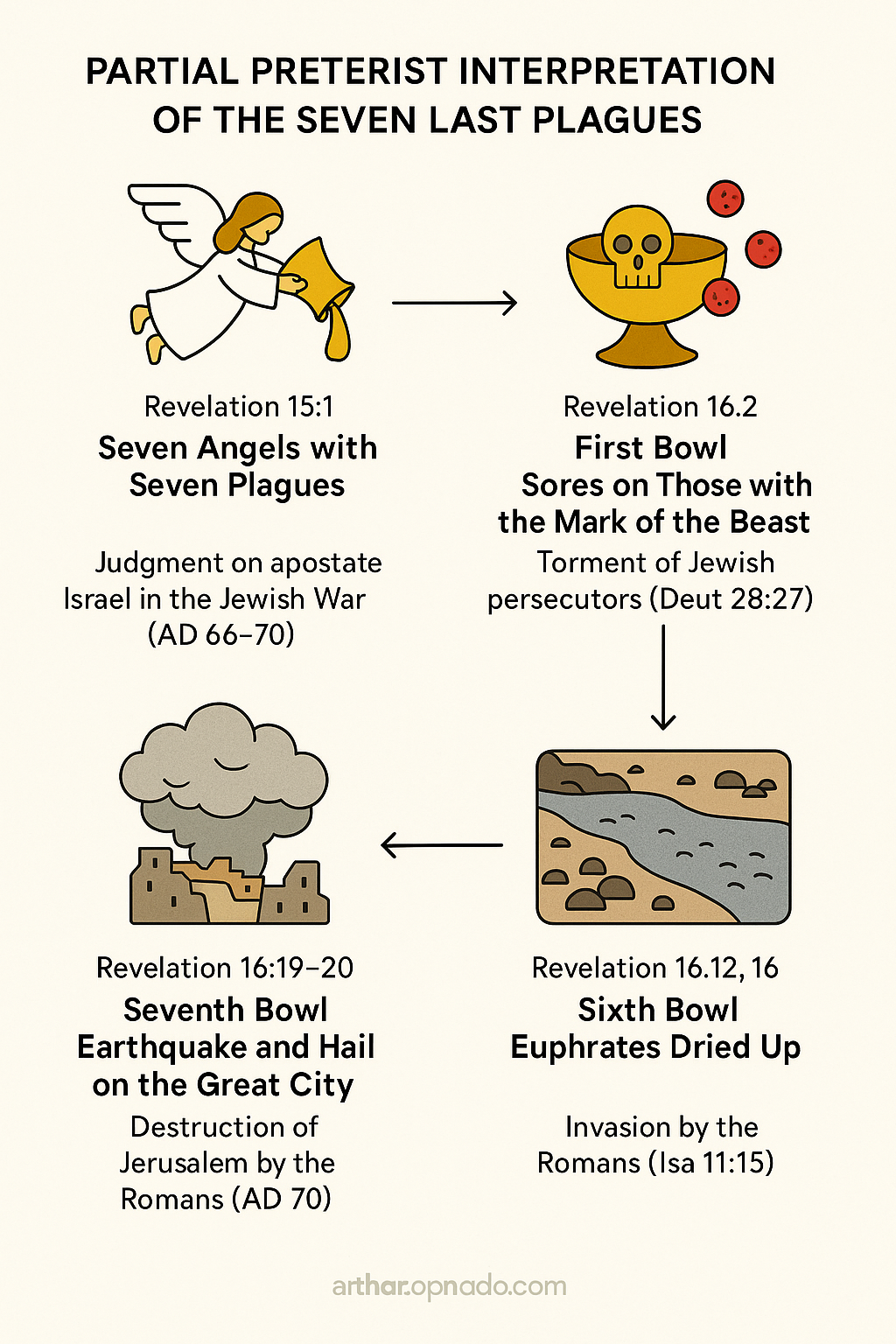
Revelation’s Seven Last Plagues: The Former Adventists Philippines Perspective

Introduction

The seven last plagues of Revelation 15–16 are among the most graphic and severe judgments depicted in apocalyptic literature. Many modern interpreters assign these events to a future, global apocalypse. However, the Former Adventists Philippines, following the partial preterist biblical perspective, interpret these plagues as judgments historically poured out upon apostate Israel in the first century. Specifically, these plagues correspond to the calamities experienced during the Jewish War (AD 66–70) and Jerusalem’s destruction. Seen through this lens, the seven plagues are covenantal sanctions from Leviticus 26 and Deuteronomy 28, unleashed upon a rebellious covenant people for rejecting the Messiah.

The Bowls of Wrath as Covenant Curses (Revelation 15:1-16:1)

​"Then I saw another great and awe-inspiring sign in heaven: seven angels with the seven last plagues; for with them God’s wrath will be completed. I also saw something like a sea of glass mixed with fire, and those who had won the victory over the beast, its image, and the number of its name, were standing on the sea of glass with harps from God. They sang the song of God’s servant Moses and the song of the Lamb:

Great and awe-inspiring are your works, Lord God, the Almighty; just and true are your ways, King of the nations. Lord, who will not fear and glorify your name? For you alone are holy. All the nations will come and worship before you because your righteous acts have been revealed.

After this, I looked, and the heavenly temple ​— ​the tabernacle of testimony ​— ​was opened. Out of the temple came the seven angels with the seven plagues, dressed in pure, bright linen, with golden sashes wrapped around their chests. One of the four living creatures gave the seven angels seven golden bowls filled with the wrath of God, who lives forever and ever. Then the temple was filled with smoke from the glory of God and from his power, and no one could enter the temple until the seven plagues of the seven angels were completed.

​"Then I heard a loud voice from the temple saying to the seven angels, 'Go and pour out the seven bowls of God’s wrath on the earth.” Revelation 15:1 - 16:1 (CSB)

Revelation 15 introduces the seven angels bearing the last plagues, which “complete the wrath of God” (Rev. 15:1). The Former Adventists Philippines view these as the climactic phase of God’s judgment on apostate Israel. The imagery draws heavily from Old Testament covenant curse passages like Leviticus 26:21-33 and Deuteronomy 28:15-68, where God promises to bring increasingly severe judgments upon Israel for persistent rebellion.¹ The sanctuary imagery (Rev. 15:5-8) also signals a covenantal lawsuit, echoing Isaiah 66:6, where God’s judgment proceeds from His temple against His enemies, identified in this context as first-century Jerusalem.

Relevant Verses and Commentary:

Leviticus 26:21-33: God warns of escalating plagues for covenant-breaking Israel.²

“If you act with hostility toward me and are unwilling to obey me, I will multiply your plagues seven times for your sins. I will send wild animals against you that will deprive you of your children, ravage your livestock, and reduce your numbers until your roads are deserted.

“If in spite of these things you do not accept my discipline, but act with hostility toward me, then I will act with hostility toward you; I also will strike you seven times for your sins. I will bring a sword against you to execute the vengeance of the covenant. Though you withdraw into your cities, I will send a pestilence among you, and you will be delivered into enemy hands. When I cut off your supply of bread, ten women will bake your bread in a single oven and ration out your bread by weight, so that you will eat but not be satisfied.

“And if in spite of this you do not obey me but act with hostility toward me, I will act with furious hostility toward you; I will also discipline you seven times for your sins. You will eat the flesh of your sons; you will eat the flesh of your daughters. I will destroy your high places, cut down your shrines, and heap your lifeless bodies on the lifeless bodies of your idols; I will reject you. I will reduce your cities to ruins and devastate your sanctuaries. I will not smell the pleasing aroma of your sacrifices. I also will devastate the land, so that your enemies who come to live there will be appalled by it. But I will scatter you among the nations, and I will draw a sword to chase after you. So your land will become desolate, and your cities will become ruins." Leviticus 26:21-33 (CSB)

Deuteronomy 28:15-68 lists curses—including disease, sword, and siege—that prefigure Revelation’s plagues.³

Isaiah 66:6: Judgment issues forth from the temple, typified in Revelation 15:5–8.⁴

"A sound of uproar from the city! A voice from the temple —the voice of the LORD, paying back his enemies what they deserve!" Isaiah 66:6 (CSB)

"After this, I looked, and the heavenly temple—the tabernacle of testimony—was opened. Out of the temple came the seven angels with the seven plagues, dressed in pure, bright linen, with golden sashes wrapped around their chests. One of the four living creatures gave the seven angels seven golden bowls filled with the wrath of God, who lives forever and ever. Then the temple was filled with smoke from the glory of God and from his power, and no one could enter the temple until the seven plagues of the seven angels were completed." Revelation 15:5-8 (CSB)


The First Four Plagues: Natural and Societal Collapse (Revelation 16:2-9)

"The first went and poured out his bowl on the earth, and severely painful sores broke out on the people who had the mark of the beast and who worshiped its image. 

The second poured out his bowl into the sea. It turned to blood like that of a dead person, and all life in the sea died.

The third poured out his bowl into the rivers and the springs of water, and they became blood. I heard the angel of the waters say,

You are just the Holy One, who is and who was, because you have passed judgment on these things. Because they poured out the blood of the saints and the prophets, you have given them blood to drink; they deserve it! I heard the altar say, Yes, Lord God, the Almighty, true and just are your judgments. 

The fourth poured out his bowl on the sun. It was allowed to scorch people with fire, and people were scorched by the intense heat. So they blasphemed the name of God, who has the power over these plagues, and they did not repent and give him glory." Revelation 16:2-9 (CSB)

The first four bowls affect the land, sea, rivers, and heavenly bodies. The Former Adventists Philippines understand these not as cosmic or ecological disasters on a global scale, but as symbolic representations of societal and national collapse during the Jewish War. The “sores” of the first plague (Rev. 16:2) reflect moral and spiritual corruption, consistent with Deuteronomy 28:27’s curse of boils. The polluted sea and rivers (Rev. 16:3-4) mirror the death and bloodshed in Galilee and Judea during Roman military campaigns, while the scorching sun (Rev. 16:8-9) symbolizes intensified persecution and judgment.⁵

Relevant Verses and Commentary:

Deuteronomy 28:27: Threatens Israel with incurable sores.⁶

“The LORD will afflict you with the boils of Egypt, tumors, a festering rash, and scabies, from which you cannot be cured." Deuteronomy 28:27 (CSB)

Luke 21:20-24: Jesus predicts Jerusalem’s siege and slaughter, matching the blood imagery.⁷

“When you see Jerusalem surrounded by armies, then recognize that its desolation has come near. Then those in Judea must flee to the mountains. Those inside the city must leave it, and those who are in the country must not enter it, because these are days of vengeance to fulfill all the things that are written. Woe to pregnant women and nursing mothers in those days, for there will be great distress in the land and wrath against this people. They will be killed by the sword and be led captive into all the nations, and Jerusalem will be trampled by the Gentiles until the times of the Gentiles are fulfilled." Luke 21:20-24 (CSB)

Malachi 4:1: A day comes when the wicked burn like stubble, reflected in the sun's plague.⁸

“For look, the day is coming, burning like a furnace, when all the arrogant and everyone who commits wickedness will become stubble. The coming day will consume them,” says the LORD of Armies, “not leaving them root or branches." Malachi 4:1 (CSB)

The Fifth and Sixth Plagues: Political and Military Devastation (Revelation 16:10–16)

"The fifth poured out his bowl on the throne of the beast, and its kingdom was plunged into darkness. People gnawed their tongues because of their pain and blasphemed the God of heaven because of their pains and their sores, but they did not repent of their works.

The sixth poured out his bowl on the great river Euphrates, and its water was dried up to prepare the way for the kings from the east. Then I saw three unclean spirits like frogs coming from the dragon’s mouth, from the beast’s mouth, and from the mouth of the false prophet. For they are demonic spirits performing signs, who travel to the kings of the whole world to assemble them for the battle on the great day of God, the Almighty. “Look, I am coming like a thief. Blessed is the one who is alert and remains clothed so that he may not go around naked and people see his shame.” So they assembled the kings at the place called in Hebrew, Armageddon." Revelation 16:10-16 (CSB)

The fifth bowl targets the beast’s throne, darkening his kingdom (Rev. 16:10). The Former Adventists Philippines identify the beast as apostate Jewish leadership allied with Roman authorities. The darkness represents the utter collapse of religious and political order in Jerusalem during the siege, fulfilling Matthew 24:29, where Jesus predicts the “darkening” of Israel’s leadership. The sixth plague dries up the Euphrates (Rev. 16:12), a metaphor for removing Jerusalem’s defenses, allowing invading forces—symbolized by the kings from the east—to enter. Josephus records how the Roman armies breached the city’s defenses, paralleling this imagery.⁹ The unclean spirits (Rev. 16:13-14) symbolize demonic deception leading Jewish leaders to stubbornly resist Rome, hastening their destruction.

Relevant Verses and Commentary:

Matthew 24:29: Describes the fall of Israel’s rulers as the darkening of heavenly bodies.¹⁰

“Immediately after the distress of those days, the sun will be darkened, and the moon will not shed its light; the stars will fall from the sky, and the powers of the heavens will be shaken." Matthew 24:29 (CSB)

Isaiah 11:15: The drying of a river to allow armies entry, a type fulfilled in Revelation 16:12.¹¹

"The LORD will divide the Gulf of Suez. He will wave his hand over the Euphrates with his mighty wind and will split it into seven streams, letting people walk through on foot." Isaiah 11:15 (CSB)


The Seventh Plague: Jerusalem’s Final Destruction (Revelation 16:17-21)

"Then the seventh poured out his bowl into the air, and a loud voice came out of the temple from the throne, saying, 'It is done! ” There were flashes of lightning, rumblings, and peals of thunder. And a severe earthquake occurred like no other since people have been on the earth, so great was the quake. The great city was split into three parts, and the cities of the nations fell. Babylon the Great was remembered in God’s presence; he gave her the cup filled with the wine of his fierce anger. Every island fled, and the mountains disappeared. Enormous hailstones, each weighing about a hundred pounds, fell from the sky on people, and they blasphemed God for the plague of hail because that plague was extremely severe." Revelation 16:17-21 (CSB)

The seventh bowl is the climax, bringing God’s judgment to its conclusion. A great earthquake (Rev. 16:18) divides “the great city”—identified by the Former Adventists Philippines as Jerusalem (cf. Rev. 11:8)—into three parts, symbolizing its political and religious fragmentation during the siege. It connects the enormous hailstones (Rev. 16:21) to actual Roman catapult stones used during the final assault, as Josephus recounts how stones weighing over a talent (75–100 lbs) were hurled into the city.¹² The symbolic and literal destruction represents the full outpouring of the covenant curses promised in Deuteronomy 28:49–68.

Relevant Verses and Commentary:

Revelation 11:8: Calls Jerusalem “the great city where also their Lord was crucified.”¹³

"The nations were angry, but your wrath has come. The time has come for the dead to be judged and to give the reward to your servants, the prophets, to the saints, and to those who fear your name, both small and great, and the time has come to destroy those who destroy the earth." Revelation 11:18 (CSB)

Deuteronomy 28:49–68: Predicts foreign siege and citywide devastation.¹⁴

"The LORD will bring a nation from far away, from the ends of the earth, to swoop down on you like an eagle, a nation whose language you won’t understand, a ruthless nation, showing no respect for the old and not sparing the young. They will eat the offspring of your livestock and your land’s produce until you are destroyed. They will leave you no grain, new wine, fresh oil, young of your herds, or newborn of your flocks until they cause you to perish. They will besiege you within all your city gates until your high and fortified walls, that you trust in, come down throughout your land. They will besiege you within all your city gates throughout the land the LORD your God has given you.

“You will eat your offspring, the flesh of your sons and daughters, the LORD your God has given you during the siege and hardship your enemy imposes on you. The most sensitive and refined man among you will look grudgingly at his brother, the wife he embraces, and the rest of his children, refusing to share with any of them his children’s flesh that he will eat because he has nothing left during the siege and hardship your enemy imposes on you in all your towns. The most sensitive and refined woman among you, who would not venture to set the sole of her foot on the ground because of her refinement and sensitivity, will begrudge the husband she embraces, her son, and her daughter, the afterbirth that comes out from between her legs and the children she bears, because she will secretly eat them for lack of anything else during the siege and hardship your enemy imposes on you within your city gates.

“If you are not careful to obey all the words of this law, which are written in this scroll, by fearing this glorious and awe-inspiring name — the LORD, your God — he will bring wondrous plagues on you and your descendants, severe and lasting plagues, and terrible and chronic sicknesses. He will afflict you again with all the diseases of Egypt, which you dreaded, and they will cling to you. The LORD will also afflict you with every sickness and plague not recorded in the book of this law, until you are destroyed. Though you were as numerous as the stars of the sky, you will be left with only a few people, because you did not obey the LORD your God. Just as the LORD was glad to cause you to prosper and to multiply you, so he will also be glad to cause you to perish and to destroy you. You will be ripped out of the land you are entering to possess. Then the LORD will scatter you among all peoples from one end of the earth to the other, and there you will worship other gods, of wood and stone, which neither you nor your ancestors have known. You will find no peace among those nations, and there will be no resting place for the sole of your foot. There the LORD will give you a trembling heart, failing eyes, and a despondent spirit. Your life will hang in doubt before you. You will be in dread night and day, never certain of survival. In the morning you will say, ‘If only it were evening! ’ and in the evening you will say, ‘If only it were morning! ’ — because of the dread you will have in your heart and because of what you will see. The LORD will take you back in ships to Egypt by a route that I said you would never see again. There you will sell yourselves to your enemies as male and female slaves, but no one will buy you.” Deuteronomy 28:49-68 (CSB)

Josephus, Wars, 5.6.3: Describes massive stones hurled into Jerusalem, like the hailstones in Rev. 16:21.¹⁵

"The engines, that all the legions had ready prepared for them, were admirably contrived; but still more extraordinary ones belonged to the tenth legion: those that threw darts and those that threw stones, were more forcible and larger than the rest, by which they not only repelled the excursions of the Jews, but drove those away that were upon the walls also. Now, the stones that were cast were of the weight of a talent, and were carried two furlongs and farther. The blow they gave was no way to be sustained, not only by those that stood first in the way, but by those that were beyond them for a great space. As for the Jews, they at first watched the coming of the stone, for it was of a white color, and could therefore not only be perceived by the great noise it made, but could be seen also before it came by its brightness."

Conclusion

The Former Adventists Philippines, drawing from the partial preterist biblical perspective, interpret Revelation’s seven last plagues as symbolic and historical judgments poured out upon apostate Israel in the first century. These plagues echo Old Testament covenant curses for rebellion, manifested concretely during the Jewish War and Jerusalem’s siege. Far from prophesying future cosmic calamities, these passages testify to God’s faithfulness in executing judgment upon a covenant-breaking people while vindicating His faithful church, thus completing the transition from the Old Covenant to the New Covenant order.


Endnotes:


1. David Chilton, The Days of Vengeance: An Exposition of the Book of Revelation (Tyler, TX: Dominion Press, 1987), 386–389.

2. Leviticus 26:21-33, Christian Standard Bible (CSB).

3. Deuteronomy 28:15–68, Christian Standard Bible (CSB).

4. Isaiah 66:6, Christian Standard Bible (CSB).

5. Kenneth Gentry, Before Jerusalem Fell: Dating the Book of Revelation (Atlanta: American Vision, 1998), 303–305.

6. Deuteronomy 28:27, Christian Standard Bible (CSB).

7. Luke 21:20-24, Christian Standard Bible (CSB).

8. Malachi 4:1, Christian Standard Bible (CSB).

9. Josephus, The Wars of the Jews, 6.4.5; cited in Chilton, Days of Vengeance, 392.

10. Matthew 24:29, Christian Standard Bible (CSB).

11. Isaiah 11:15, Christian Standard Bible (CSB).

12. Josephus, Wars of the Jews, 5.6.3.

13. Revelation 11:8, Christian Standard Bible (CSB).

14. Deuteronomy 28:49–68, Christian Standard Bible (CSB).

15. Josephus, Wars of the Jews, 5.6.3.

FEATURED POST

"Unpacking the Story Behind Ellen White’s Head Injury"

When looking at the history of the Seventh-day Adventist (SDA) movement, one story stands out: at nine years old, Ellen Harmon (later White)...

MOST POPULAR POSTS