Friday, November 21, 2025

"Yahweh, Not Yahuwah: How a 3,400-Year-Old Inscription Settles the Divine Name Debate!"


For many years, Christians and Bible readers have debated the exact pronunciation of God’s sacred name YHWH, the Tetragrammaton. Some movements today strongly promote the form “Yahuwah,” insisting it is the original name of the God of Israel. But what if archaeology could help answer this ancient question?

In one of the most remarkable discoveries in recent years, a 3,400-year-old inscription from Soleb, Sudan, has emerged as the earliest extra-biblical reference to the God of Israel, and it doesn't support “Yahuwah.” It supports Yahweh.

Let’s explore why this matters not only for scholars, but for everyday believers who want confidence that our faith stands firmly in both history and Scripture.

1. The Name that Appears 6,823 Times

The divine name YHWH appears over 6,800 times in the Old Testament. It is God’s personal covenant name, the name He revealed to Moses. But pronunciation? Ancient Hebrew wrote only consonants. So to recover the sound of the name, we rely on:

  • linguistic patterns,

  • early Hebrew theophoric names (e.g., Yah, Yahu),

  • ancient transcriptions in other languages,

  • and archaeological evidence.

Across these lines of evidence, one pronunciation rises to the top: Yahweh (Yah-weh), not Yahuwah. Not Yehowah. Certainly not Jehovah (a much later hybrid).

2. The Sacred Name Debate: What’s the Issue?

The Sacred Name Movement (SNM) argues that God’s name must be spoken only in “restored Hebrew form,” often insisting on:

  • Yahuwah

  • Yahowah

  • Yehovah

But here is the problem: No ancient inscription uses these forms. Not one from Israel, Egypt, Canaan, or Babylon. Meanwhile, forms that look like Yahweh appear across inscriptions, tablets, and ancient translations. A sincere desire to honour God’s name is good. But sincerity must walk with evidence.

Why “Yahweh” and not “Yahuwah”?

  • Most modern Hebrew/semantics scholars accept that the original pronunciation was Yahweh (yāh-weh). The form “Jehovah” arises from combining the consonants YHWH with the vowel points of “Adonai” (Lord) in the Masoretic text, a hybrid, later advent. 

  • While exact pronunciation cannot be known for certain (ancient Hebrew lacked vowel letters), the preponderance of evidence supports Yah-weh rather than Yah-u-wah.

  • The short form “Yah” (as in Hallelu-yah) also points to Yah as the first syllable.

In short, when someone argues for “Yahuwah” as the “true” divine name, you can ask: what is the scriptural, linguistic, or archaeological basis for the “-uwah” syllable? By contrast, Yahweh has far stronger backing.

3. The Discovery at Soleb: Yahweh in Stone

The turning point in this discussion comes from the Temple of Soleb, built by Pharaoh Amenhotep III around 1400 BC, the era many scholars connect with the Exodus. Egyptologists studying the temple’s carved pillars found lists of foreign peoples defeated or encountered by Egypt. One of the pillar inscriptions reads, in Egyptian transliteration: “Land of the Shasu Nomads of Yhwꜣ.” It is an Egyptian inscription referring to nomads associated with Yahweh. In Egyptian transliteration:

  • tꜣ šꜣsw Yhwꜣ, which means “the land of the nomads (shasu) of Yhwꜣ”. 
  • “šꜣsw” (shasu) is the Egyptian word for nomads or “wanderers”.

  • Yhwꜣ: this is read as “Yahweh” (or equivalent). Scholars interpret the four consonants Y-H-W-A as the deity’s name, not a place name. 

  • The context: the Egyptians depicted the subjugated peoples, and this group is identified solely by their god (“of Yahweh”). 

This makes it the oldest known reference to Yahweh outside the Bible. Imagine that: A 3,400-year-old stone carving in Sudan naming the God of Israel before Israel even entered Canaan.

Why this matters

  • If the inscription is dated to c. 1400 BC (late 15th century BC), then by that date, Egypt already knew of a people whose god was Yahweh. 

  • It correlates surprisingly well with a “biblical” early Exodus chronology (c. 1446 BC) and 40 years wandering and settling. (As per 1 Kings 6:1 and traditional readings.) 

  • For those who argue that the Israelites and Yahweh worship did not exist until much later, this finding places them firmly in the 15th century BC.

  • It also strongly reinforces that “Yahweh” was a divine name used by a nomadic people group (shasu) identifiable with early Israel. 

Putting it into an apologetic setting

When someone says, “No proof exists outside the Bible for the name of God”, you can reply: “Actually, yes, this Soleb inscription is the earliest known extra-biblical mention of the god Yahweh.” And then ask: “Would those favoring ‘Yahuwah’ offer an inscription using that form?” At present, none of the mainstream epigraphic materials use Yahuwah.

But here is the problem: No ancient inscription uses these forms. Not one from Israel, Egypt, Canaan, or Babylon. Meanwhile, forms resembling Yahweh appear in inscriptions, tablets, and ancient translations. A sincere desire to honour God’s name is good. But sincerity must walk with evidence.

4. Why This Supports “Yahweh,” Not “Yahuwah”

The inscription spells the divine name with the equivalent of the consonants Y-H-W-A. Linguistically, this fits perfectly with the scholarly reconstruction of Yahweh. It does not fit:

  • Yahuwah (Y-H-W-U-W-A)

  • Yahowah

  • Yehovah

There is zero archaeological evidence for those forms in the Bronze Age or Iron Age. The Soleb inscription aligns with:

  • the shorter Hebrew forms “Yahu” and “Yah,”

  • early Israelite theophoric names like EliYahu (Elijah),

  • and the consensus of Hebrew linguistics.

History doesn’t whisper ‘Yahuwah.’ It clearly speaks ‘Yahweh.’

A Powerful Apologetic Point

For believers, this discovery strengthens two powerful truths:

  • God’s name was known among ancient peoples exactly as Scripture describes

  • The earliest archaeological record supports the pronunciation Yahweh

This is a beautiful example of how archaeology and the Bible walk hand-in-hand, not in conflict but in confirmation.

How to Use This in Apologetic Conversations

If someone insists that “Yahuwah” is the only true name:

You can gently ask:

  1. Where is the historical evidence?
    Are there any ancient inscriptions using “Yahuwah”? → None so far.

  2. Why does the earliest inscription, 1400 BC, use Yahweh instead?

  3. Why do older Hebrew names end in “-yah” or “-yahu,” not “-yahuwa”?

  4. Why do historians, linguists, and archaeologists all converge on Yahweh?

This approach keeps the discussion kind, respectful, and rooted in facts, not speculation. Honouring God’s name means embracing the God of truth. Evidence matters.

Final Thoughts: Faith Meets History

The Soleb inscription is more than just an old carving in Sudan. It is a reminder that:

  • The God who revealed Himself to Moses is a God rooted in real history.

  • His name was known long before critics claimed Israel “invented” it.

  • And the ancient world knew Him as Yahweh.

For Christians today, this strengthens our confidence that Scripture is aligned with history, even down to the divine name itself. The stones cry out, and they say Yahweh.

Addressing the Sacred Name Movement (SNM) Concerns

The SNM often emphasises preserving Hebrew names and claims “Yahuwah” (or “Yehowah”, “Yahowah”) is the original, sometimes claiming the accepted “Yahweh” is compromised or corrupted.

Here’s how you can engage:

  1. Preserve Hebrew Names? Good—but use evidence.
    Preserving Hebrew names is laudable, but it must go hand-in-hand with scholarship. The linguistic evidence favours Yahweh rather than Yahuwah.

  2. Where is “Yahuwah” in ancient inscriptions?
    To my knowledge, no ancient inscription from the Bronze Age or early Iron Age uses the precise form “Yahuwah”. The Soleb form is Y-H-W-A (Yhwꜣ), not Y-H-W-U-W-A.

  3. Pronunciation vs reverence.
    Some may argue that because the pronunciation was lost, we should default to one or another form. True, but scholarly consensus leans on Yah-weh. Moreover, revering the name is distinct from insisting on an unattested variant.

  4. Focus on substance not just spelling.
    The key is: the God of Israel is referred to by name in ancient epigraphy. That strengthens confidence in the biblical record. The argument over extra syllables is secondary, important, but not essential for the main apologetic claim (that God’s name was known).


REFERENCES 

Armstrong Institute of Biblical Archaeology. (n.d.). The Soleb inscription: Earliest discovered use of the name Yahweh.

Bible Archaeology Report. (2019, March 8). Three Egyptian inscriptions about Israel.

Bible Archaeology Report. (n.d.). The Soleb inscription: Yahweh and the Shasu nomads. 

Britannica. (n.d.). Yahweh.

eScholarship. (n.d.). The land of the šꜣsw-nomads of Yhwꜣ at Soleb.

eScholarship. (n.d.). Yhwꜣ and the Shasu nomads: Egyptian references to Yahweh.

FaithWriters. (n.d.). Tetragrammaton and the name of God.

GotQuestions Ministries. (n.d.). What is YHWH?

SciSpace. (n.d.). The land of the S3sw-nomads of yhw3 at Soleb.

SciSpace. (n.d.). Interpretation of Yhwꜣ in Egyptian inscriptions.

Wikipedia. (n.d.). Jah.

Wikipedia. (n.d.). Soleb.

Wikipedia. (n.d.). Tetragrammaton.


Former Adventists Philippines

“Freed by the Gospel. Firm in the Word.”

For more inquiries, contact us:

Email: formeradventist.ph@gmail.com

Website: formeradventistph.blogspot.com

Facebook: https://www.facebook.com/groups/formeradventistph

Thursday, November 20, 2025

The 1844 Investigative Judgment:Why this teaching is anti-Gospel?


Since 2021, the Investigating Adventism program of the FAP Ministry has been consistently addressing this crucial issue. Through the ongoing exposure of false teachings, many members of the SDA denomination have already been awakened and have eventually decided to separate from their church. For this reason, FAP Ministry sincerely gives thanks to the Lord for His unending guidance and for using our ministry as an instrument from the beginning until now. At this point, we will employ the Question-and-Answer method of study so that the subject may become clearer and easier to understand.

For many Seventh-day Adventist (SDA) members, the doctrine of the Investigative Judgment said to begin in 1844 is considered the heart of Adventist identity. Leaders have called it the “central pillar” of the movement. Yet for others, especially Christians outside the SDA church, this teaching raises deep questions about the gospel of grace.

This blog aims to explain the SDA doctrine in simple terms, explore why it remains controversial, and show how it contrasts with the New Testament message of salvation through Christ alone.

1. What Do SDAs Officially Teach About the 1844 Investigative Judgment?

In SDA Fundamental Belief #24 (Christ’s Ministry in the Heavenly Sanctuary), the church teaches that after His ascension, Jesus began His priestly ministry in the heavenly sanctuary. According to this doctrine:

  • In 1844, Jesus entered the Most Holy Place to begin the second phase of His atonement work.

  • This phase is called the Investigative Judgment.

  • The purpose is to examine the lives of professed believers, dead and living, to determine who is ready for eternal life.

  • This work also “vindicates” God before the universe.

The key Bible verse used to support the 1844 date is Daniel 8:14: “Unto 2300 days; then shall the sanctuary be cleansed.”

2. Why Is This Doctrine So Important to SDA Identity?

Ellen G. White, Adventism’s prophetic authority, wrote:

“The scripture which above all others had been both the foundation and the central pillar of the advent faith was… Daniel 8:14.” (The Great Controversy p. 409)

Because of this, the doctrine is deeply tied to Adventist history. However, many Adventists quietly admit it is also the most difficult doctrine to explain, even to their own members.

3. How SDAs Connect the Doctrine With the Day of Atonement

SDAs believe the Investigative Judgment is the heavenly counterpart of Leviticus 16, where the High Priest cleansed Israel’s earthly sanctuary once a year. They teach that:

  • Christ is now cleansing the “record of sins” in heaven.

  • Before sins can be finally removed, the records must be examined.

  • This investigation determines who is worthy to enter God’s kingdom.

This makes salvation partly dependent on one’s performance.

4. SDA View: Jesus Entered the Holy Place (Not the Most Holy) in AD 31

Early Adventist pioneers, including Ellen White, taught that:

  • After Jesus ascended, He entered only the Holy Place in heaven.

  • He did not enter the Most Holy Place until 1844.

But this clashes with the New Testament.

5. Bible Teaching: Jesus Entered the Most Holy Place at His Ascension

Verses like Hebrews 6:19–20 and Hebrews 9:12 clearly state:

  • Jesus has already entered the “inner sanctuary” (Most Holy Place)

  • He entered once for all

  • He achieved eternal redemption immediately

This means the idea of a “delay” until 1844 cannot be supported by Scripture.

6. SDA Teaching: The Judgment Is About Believers Only

Ellen White wrote that in this judgment:

“the only cases considered are those of the professed people of God.” (The Great Controversy p. 480)

This creates the idea that even believers face a salvation test depending on the completeness of their confession and obedience.

7. Where the Investigative Judgment Conflicts with the Gospel

Here is the main doctrinal tension:

SDA teaching:

Your eternal destiny is decided based on your deeds, which must prove your loyalty to God and your victory over sin.

Bible teaching:

Your eternal destiny is secured through faith in Christ, not by your performance.

The New Testament repeatedly teaches salvation by grace, not works:

  • Ephesians 2:8–9

  • Titus 3:5

  • Romans 8:1

  • John 5:24

The issue is not whether Christians should obey God (we should!). The issue is making obedience a condition for acceptance before God. That becomes “Galatianism,” mixing faith with works as the basis of salvation.

8. Ellen White’s Perfection Teaching

Ellen White wrote many statements teaching that believers must reach sinless perfection before Christ returns, and that:

  • Perfect commandment-keeping is essential for salvation.

  • Christ will only return when His people have “perfectly reproduced” His character.

  • During the “time of trouble,” believers must stand before God without a mediator (no intercessor!).

This contradicts the New Testament promise that Christ’s mediation is everlasting and that salvation is firmly anchored in His perfection, not ours.

9. Can a Christian Say “I Am Saved”? SDA vs. Bible

Ellen White repeatedly warned that no one should ever say “I am saved,” because:

  • One may still have unconfessed sins.

  • Salvation is not secure until after passing the Investigative Judgment.

  • Full assurance is seen as dangerous presumption.

But the Bible directly teaches:

  • Believers have eternal life (1 Jn. 5:13)

  • Believers shall be saved through faith (Acts 16:31)

  • Believers have passed from death to life (Jn. 5:24)

  • Believers have been saved by grace (Eph. 2:8)

The New Testament invites confident assurance, not lifelong anxiety.

10. Comparing Two Systems: Gospel vs. Investigative Judgment

1844 Investigative Judgment         New Testament Gospel
Christ’s blood pollutes heaven         Christ’s blood cleanses
Sins blotted out only after 1844         Sins forgiven & blotted out at repentance
Focus on human works         Focus on Christ’s finished work
Must reach sinless perfection         Trust in Christ’s perfection
Salvation is uncertain         Salvation is assured in Christ

11. The Good News: Jesus Was Already Judged in Our Place

The New Testament declares a different kind of judgment:

  • Christ took our judgment on the cross. (1 Peter 2:24)

  • His righteousness is credited to us. (Romans 4:24)

  • Believers already passed from death to life. (John 5:24)

  • There is now no condemnation for those in Christ. (Romans 8:1)

The final judgment reveals how people responded to God’s saving grace it is not a fearful process to determine whether believers are “good enough.”

Final Reflection

The Investigative Judgment doctrine attempts to explain the 1844 disappointment, but in doing so, it unintentionally creates a system where:

  • Assurance is impossible,

  • Perfection becomes the requirement for salvation,

  • Christ’s finished work seems unfinished until human character reaches perfection.

But the gospel offers something far more beautiful:

“Whoever believes has eternal life.” (John 5:24)

Our confidence is in Christ’s perfect obedience, not our imperfect efforts. Salvation is not a future possibility; it is a present reality for all who trust in Him.


Former Adventists Philippines

“Freed by the Gospel. Firm in the Word.”

For more inquiries, contact us:

Email: formeradventist.ph@gmail.com

Website: formeradventistph.blogspot.com

Facebook: https://www.facebook.com/groups/formeradventistph

The Cross, Grace, and Human Will: A Reformed Arminian Response to D.A. Carson


Introduction

In The Difficult Doctrine of the Love of God, D.A. Carson makes a profound statement that often stirs deep discussion in theological circles:

“If Christ died for all people with exactly the same intent… then the ultimate distinguishing mark between those who are saved and those who are not is their own decision, their own will. That is surely ground for boasting.”

Carson, coming from a Reformed (Calvinist) tradition, raises an important question about the relationship between divine grace and human decision. His concern is clear: if salvation depends in any way on human choice, then perhaps we contribute something to our own redemption, and that would undermine the glory of God.

But how does a Reformed Arminian (sometimes called “Wesleyan-Arminian”) respond?

God’s Grace Takes the First Step

Reformed Arminians affirm, without hesitation, that salvation begins with God. Human beings, corrupted by sin, cannot and would not come to God on their own. This is why Scripture teaches that grace must first awaken the heart:

“No one can come to Me unless the Father who sent Me draws him.”— John 6:44

This drawing of the Spirit called prevenient grace is God’s loving initiative that enables all people to respond freely to His offer of salvation. It does not guarantee belief, but it restores the ability to respond.

Therefore, when someone believes in Christ, it is not an act of proud independence, but a response made possible by grace itself.

Faith Is Not a Work, It Is Surrender

Carson worries that if salvation depends on our decision, then we have reason to boast. But the Arminian response is simple: faith is not a work; it is the opposite of work.

Paul writes,

“For by grace you have been saved through faith and this is not your own doing; it is the gift of God, not a result of works, so that no one may boast.” — Ephesians 2:8–9

Faith is not something we perform to earn salvation; it is the empty hand that receives what Christ has already accomplished. In Asian culture, this can be beautifully compared to the act of bowing when receiving a gift; it is not a boastful act but a gesture of humility and gratitude.

Thus, when a sinner believes, they are not saying, “Look at what I did,” but “Lord, I can do nothing without You.”

The Scope of the Cross: Sufficient for All, Efficient for the Believer

Reformed Arminians hold that Christ’s atonement is universal in provision but conditional in application. That is, Jesus’ death is sufficient for all humanity, yet it becomes effective only for those who trust in Him.

“He is the atoning sacrifice for our sins, and not only for ours but also for the sins of the whole world.”— 1 John 2:2

This view honors both God’s justice (since He does not force salvation) and His love (since He genuinely offers salvation to all). The cross stands as an open invitation, not a limited transaction.

Grace and Human Freedom: Cooperation, Not Competition

Reformed Arminian theology seeks to maintain balance. God’s sovereignty and human free will are not enemies; they operate in harmony. God initiates; humans respond. This is what theologians call synergism, but not in the sense of equal contribution; rather, it is a relationship where the Creator empowers the creature to say “yes” or “no” to His offer.

This does not diminish God’s glory; it magnifies it. For what greater display of divine power can there be than to move human hearts freely toward love and faith?

The Real Ground for Boasting

Carson concludes that if salvation depends on one’s decision, it leads to boasting. But Scripture reminds us that the only legitimate boast for the believer is in the Lord:

“Let the one who boasts, boast in the Lord.”— 1 Corinthians 1:31

The believer’s faith is itself a testimony of God’s grace at work. The only difference between the saved and the lost is not human superiority, but the response of humility to divine love.

Conclusion

D.A. Carson’s challenge pushes us to think deeply about grace and human response. Yet from the Reformed Arminian lens, faith is never a cause for pride. It is a humble acceptance of what God has already done through Christ.

The distinction between the saved and the unsaved is not found in willful boasting, but in grace received versus grace resisted. Every “yes” to God is made possible by God Himself.

So, the glory still belongs to Him alone.

“To God be the glory, great things He has done.”


FEATURED POST

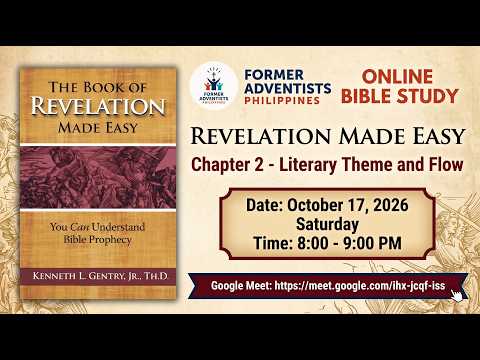
Video & English Outline: Revelation Made Easy: Chapter 2 - Literary Theme and Flow

Former Adventists Philippines Prophecy Bible Study Guide Revelation Made Easy: Chapter 2 - Literary Theme and Flow (October 17, 2026, Saturd...

MOST POPULAR POSTS