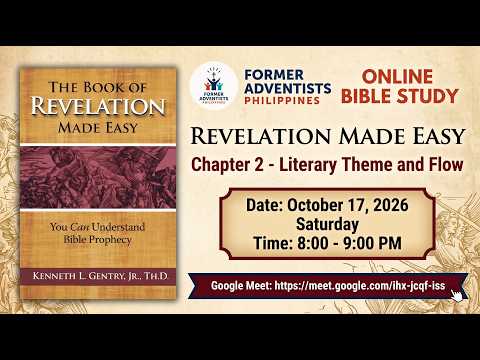
Saturday, October 17, 2026

Video & English Outline: Revelation Made Easy: Chapter 2 - Literary Theme and Flow


Former Adventists Philippines Prophecy Bible Study Guide

Revelation Made Easy: Chapter 2 - Literary Theme and Flow
(October 17, 2026, Saturday at 8:00 PM)
Prepared by: Bro. Ronald Obidos
Google Meet Link: https://meet.google.com/ihx-jcqf-iss


(3 mins) | Opening Prayer

Leader's Guide: Begin with a relaxed, welcoming tone to help everyone settle in and leave behind any intimidating or fearful ideas they may have heard about the book of Revelation growing up.

Sample Prayer: "Heavenly Father, thank You for bringing us together today. As we open the book of Revelation, we ask the Holy Spirit to give us peace, wisdom, and clear eyes to see what You originally spoke to Your first-century church. Remove any fear or confusion, and help us see Jesus seated on His throne in victory and faithfulness. In Jesus' name, Amen."

(7 mins) | Icebreaker / Hook

Icebreaker Question: "Have you ever received a screenshot of a single text message without seeing the rest of the chat, or walked into a room right in the middle of a conversation, and completely misunderstood what was going on?"

Leader's Bridge to the Lesson:
  • When we read a letter or a book without paying attention to when it was written and how the author speaks, we can easily get the wrong idea
  • The two biggest mistakes readers make in Revelation are overlooking John's clear statements about when these events would happen and missing his symbolic style of writing.

  • If we ignore John's near-term time frame, we end up turning Revelation upside down, taking events John said were at the beginning of Christian history and pushing them to the very end.
(15 mins) | Core Text & Simplified Reading

Passage to Read Aloud (9 Verses Total): Revelation 1:1, 3, 7, 9 and Revelation 5:1–5.

"The Revelation of Jesus Christ, which God gave Him to show to His bond-servants, the things which must shortly take place... Blessed is he who reads and those who hear the words of the prophecy, and heed the things which are written in it; for the time is near... Behold, He is coming with the clouds, and every eye will see Him, even those who pierced Him; and all the tribes of the earth will mourn over Him. Even so. Amen... I, John, your brother and fellow partaker in the tribulation and kingdom and perseverance which are in Jesus, was on the island called Patmos, because of the word of God and the testimony of Jesus." (Rev. 1:1, 3, 7, 9)

"And I saw in the right hand of Him who sat on the throne a book written inside and on the back, sealed up with seven seals. And I saw a strong angel proclaiming with a loud voice, 'Who is worthy to open the book and to break its seals?' ... and one of the elders said to me, 'Stop weeping; behold, the Lion that is from the tribe of Judah, the Root of David, has overcome so as to open the book and its seven seals.'" (Rev. 5:1–2, 5)

Q1: What is the main theme verse of Revelation, and what event is it actually describing?

A: John states his main theme right at the start in Revelation 1:7: "Behold, He is coming with the clouds, and every eye will see Him, even those who pierced Him; and all the tribes of the earth will mourn over Him."

A: While modern readers often assume at first glance that this verse describes the future, history-ending Second Coming of Christ, strong biblical and contextual evidence points in another direction.

A: Rather than the end of the world, Revelation 1:7 is a judgment prophecy against first-century Jerusalem, fulfilled when the Roman generals Vespasian and Titus destroyed the city and the Temple in A.D. 70.

Q2: How does the immediate context around Revelation 1:7 prove that John is talking about his own generation?

A: The golden rule of reading any document is "Context. Context. Context".

A: Before the theme verse: In verses 1 and 3, John insists that he is writing about "the things which must shortly take place" because "the time is near". It would make no sense for John to urge first-century Christians to read and obey his message because the time was near, only to give them a main theme that wouldn't happen for thousands of years.

A: After the theme verse: 
In verse 9, John reminds his readers that he is their brother and fellow partaker sitting in exile on Patmos during their grueling first-century persecution. God was promising near-term vindication for those suffering believers, not telling them He would avenge their pain millennia later.

Q3: How does the courtroom scene in Revelation 4–5 set up the flow of the whole book?

A: Revelation is structured like a courtroom drama, with the word "throne" showing up 47 times across 18 of its 22 chapters.

A: In chapter 4, God sits on His judicial throne surrounded by lightning and thunder. In chapter 5, He holds a legal scroll written front and back and sealed with seven seals, which Jesus (the Lion of Judah) steps forward to open so that judgment can be carried out.

(15 mins) | Interactive Discussion & "Interesting Ideas"

Q1: Symbolism Breakdown: If nobody saw Jesus physically floating down on a literal cloud in A.D. 70, why does John say, "He is coming with the clouds"?

A: In the Bible's apocalyptic style, God "coming on the clouds" is symbolic language for when He steps into history to bring judgment upon a nation.

A: For example, in Isaiah 19:1, the prophet warned that "the Lord is riding on a swift cloud, and is about to come to Egypt," a judgment fulfilled historically when the Assyrian king Esarhaddon conquered Egypt in 671 B.C., without anyone seeing God physically sitting on a cloud.

A: Jesus used this exact same language at His trial in Matthew 26:64, telling the Jewish high priest and those standing around him, "hereafter you shall see the Son of Man sitting at the right hand of Power, and coming on the clouds of heaven".

A: This also matches Jesus' Parable of the Vineyard Owner (Matt. 21:33–45) and the Wedding Feast (Matt. 22:7), where the Lord "comes" in judgment against the leaders who killed His Son by sending armies to destroy those murderers and burn their city in A.D. 70.

Q2: Word Study: Who are "those who pierced Him" and "all the tribes of the earth"?

A: "Those who pierced Him": Even though Roman soldiers physically nailed Jesus to the cross, the New Testament repeatedly places the covenantal blame on first-century Israel for demanding His death (Matt. 27:25; John 19:15; Acts 2:23; 5:30; 7:52; 1 Thess. 2:14–16). Because those specific people have been dead for over 1,900 years, this judgment had to fall in the first century while they were still alive.

A: "All the tribes of the earth": The Greek word translated "earth" (ge) is frequently translated as "land" throughout the New Testament, referring specifically to the Promised Land of Israel (e.g., Matt. 2:20–21; Acts 10:39). Furthermore, the Greek word for "tribe" (phulē) most often points to the twelve Jewish tribes living in that land.

A: Literal Bible translations actually read: "and wail over him shall all the tribes of the land", pointing directly to the mournful judgment of Jerusalem in A.D. 70 that Jesus warned about in Luke 19:41–44, Luke 21:20–24, and the Olivet Discourse in Matthew 24:30, 34.

Q3: Answering Popular Questions: What if someone brings up 2 Peter 3:8 ("one day is as a thousand years") or asks if "every eye" means the whole globe?

A: On "God's Timing" (2 Pet. 3:8): Peter is making a theological point about how God views time to answer mockers who claimed God's promises had failed; John, on the other hand, is giving urgent historical instructions to suffering Christians about what they were about to face shortly.

A: On "Every Eye Will See Him": In everyday biblical language, words like "all" and "every" often describe a major public event rather than literally every single person on the planet, just like Matthew 3:5 says "all Judea" went out to hear John the Baptist. Moreover, John immediately defines who "every eye" refers to in the next phrase: "even [that is] those who pierced Him".

Q4: Creative Comparison: The Courtroom Divorce & The Tale of Two Women

Leader's Analogy: Invite the group to picture Revelation 4–21 as a dramatic covenantal court case involving two women: an unfaithful wife (the Harlot) and a faithful new wife (the Bride).

The Marriage & The Betrayal: In the Old Testament, God was a Husband to Israel (Isa. 54:5; Jer. 31:31–32), so whenever Israel turned away from Him and shed innocent blood, the prophets called it spiritual adultery and harlotry (Jer. 3:9; 5:7; Eze. 23:37).

The Divorce Scroll: Because of first-century Jerusalem's spiritual harlotry (called "Babylon the Great, the Mother of Harlots" in Rev. 17:4–5), the seven-sealed scroll in God's hand (Rev. 5:1) functions as a legal certificate of divorce, echoing Jeremiah 3:8 and Ezekiel 2:9–3:1, while the seven seals, trumpets, and vials mirror the seven-fold covenant punishments of Leviticus 26.

The Execution by Stoning: Under Old Testament law, the capital punishment for adultery and harlotry was stoning (Lev. 20:10; Deut. 22:21), which is why Revelation 16:21 pictures Jerusalem's destruction with 100-pound hailstones crashing down from heaven.

The New Bride: Once the unfaithful harlot city is judged and the obsolete Old Covenant temple is removed in A.D. 70 (Heb. 8:13), a radiant new Bride steps onto the scene in Revelation 19:9 and 21:2, the "New Jerusalem" coming down from heaven, representing the Christian Church taking the place of the old system in God's redemptive plan (Gal. 4:25–26; Heb. 12:22; Matt. 21:43).

(12 mins) | Real-Life Application

Q1: Knowing how devastating the A.D. 70 fall of Jerusalem was, ending the Old Covenant temple and sacrifices forever, how does this strengthen our confidence in Jesus today?

A: History confirms that Jesus' warnings came true down to the smallest detail: as the Jewish historian Josephus and archaeologist Kathleen Kenyon recorded, Titus's Roman armies burned Jerusalem, tore the Temple stones apart, and permanently ended the Old Testament sacrificial system in A.D. 70.

A: Because Jesus' words were fulfilled within that exact first-century generation just as He promised (Matt. 24:34), we don't need to live in fear of sensational end-times news headlines; we can trust that God's Word is completely reliable and that Jesus reigns from His throne right now.

Q2: Since the Church is now the "New Jerusalem" and the Bride of Christ, how should that shape the way we live this week?

A: In the Old Covenant, worship was tied to a physical building and animal sacrifices in earthly Jerusalem, which grew obsolete and disappeared in A.D. 70 (Heb. 8:13).

A: In the New Covenant, we are the heavenly Jerusalem and the Bride prepared for her Husband (Heb. 12:22; Rev. 21:2). This week, instead of treating faith like a ritual tied to a physical place, we are called to guard our hearts against modern idols, stay faithful to Jesus in our daily walk, and actively bear the fruit of God's Kingdom wherever He has placed us (Matt. 21:43).

(5 mins) | Takeaways & Wrap-up

One-Sentence Summary: Revelation is not a fearful puzzle about the end of the planet, but a powerful courtroom drama showing how Jesus judged first-century Jerusalem in A.D. 70 to bring the obsolete Old Covenant to a close and establish the Christian Church as His glorious New Covenant Bride.

Teaser for Next Session: Keep these images of the Harlot and the siege of Jerusalem in mind. In our upcoming sessions, we will unpack the eye-opening details of how the Harlot's identity and the 100-pound hailstones of Revelation 16 matched the real historical siege of A.D. 70!

(3 mins) | Closing Prayer

Leader's Guide: Invite group members to briefly share any practical needs they are carrying this week (work stress, family concerns, health, or staying strong in their walk with God), then close in prayer.

Sample Prayer: 
"Lord Jesus, thank You that You are the faithful King who keeps every promise. Thank You for bringing us into the New Covenant as Your treasured Bride, the New Jerusalem. Help us walk through this week with unshakable peace, knowing You sit on the throne, and empower us to produce the good fruit of Your Kingdom in our homes and workplaces. We also lift up the practical needs shared in our group today, and ask that You meet each brother and sister with Your grace and provision. In Your mighty name we pray, Amen."

Friday, October 16, 2026

Attention SDA Members! Tired of guessing if Ellen G. White’s writings line up with the Bible?


Attention SDA Members!

Tired of guessing if Ellen G. White’s writings line up with the Bible?  

Visit EGWFinder.com (https://egwfinder.com), a tool that checks her words against Scripture, side‑by‑side.  

Why it matters:

- See the real contrast between EGW and the Word of God.  

- Test doctrines, not just traditions.  

- Discover truth without filters.  

Invitation:

We challenge every SDA layman, student, and pastor: Check it for yourself. Don’t just take our word; let the Bible speak.  

“EGW vs. the Bible: Dare to Compare. Visit EGWFinder.com today.”


Unmasking "Old Testament Prophets" (Oct 10–16): Why Studying Elijah, Samuel, and Huldah Actually Destroys the Case for Ellen G. White


Welcome back to the Former Adventists Philippines Blog, brothers and sisters! Kumusta kayo? If you have ever sat inside a Sabbath School class wondering why a study on ancient Hebrew kings and prophets somehow always ends up at a farm in 19th-century Maine, this week’s review is for you.

Today, we are walking through Sabbath School Lesson 3 (October 10–16), titled Old Testament Prophets. If you peek at the Teachers Comments at the back of the quarterly, the authors openly admit the real agenda for the week: the entire study of Old Testament prophetic ministry is designed as a backdrop to help church members accept the prophetic authority of Ellen G. White.

Let’s examine this lesson day by day using sound biblical exegesis, standard hermeneutics, and the clear lenses of New Covenant Theology.

Sabbath Afternoon: The "Heavenly GPS" and the Bait-and-Switch

What the Lesson Claims:

The introduction uses a comparison from 2 Chronicles 20:20, where King Jehoshaphat urges Judah to trust the Lord to be established and trust His prophets to succeed, and likens Old Testament prophets to a spiritual Global Positioning System (GPS) that guides believers toward heaven. It immediately emphasizes that these prophets were fragile, ordinary people who battled fear, anger, discouragement, and hard lives just like us.

In the historical context of 2 Chronicles 20, Jehoshaphat was not laying down a timeless requirement that every generation must have a denominational visionary in order to prosper. Judah was facing an invading coalition of Moabites and Ammonites, and a Levite named Jahaziel gave a specific, one-time prophetic assurance that God would win that specific battle without Judah even needing to fight. Under New Covenant Theology, we no longer rely on an Old Covenant prophetic office as our "heavenly GPS". As Hebrews 1:1–2 declares, God spoke in various ways through the prophets in the past, but in these last days He has spoken to us finally and fully in His Son, Jesus Christ! Today, every born-again believer has the indwelling Holy Spirit and the completed apostolic Scriptures to guide them into all truth (John 16:13; 2 Timothy 3:16–17).

The lesson equates the canonical prophets of Israel with modern extra-biblical leadership, while preemptively lowering the standard of prophetic reliability by stressing how fragile and mistake-prone prophets were as human beings.

If Jesus Christ is the final Word of God and the Holy Spirit already lives inside every believer under the New Covenant, why does a church still need a 19th-century mediator to act as its spiritual GPS?

Sunday, October 11: The Humanity of Prophets (Elijah’s Burnout)

What the Lesson Claims:

Looking at James 5:17–18 and 1 Kings 18–19, the lesson contrasts Elijah’s dramatic victory calling down fire on Mount Carmel with his deep despair in the wilderness when he asked God to end his life. It suggests Elijah was battling depression and feeling like a ministerial failure because Israel remained in apostasy despite his zeal for the covenant, proving he had a frail human nature just like ours.

When James 5:17–18 mentions that Elijah shared our human nature, James is not making excuses for prophetic blunders; he is encouraging ordinary Christians that our fervent prayers are powerful and effective! Furthermore, from a Biblical perspective, 1 Kings 19 is a beautiful picture of how God’s prevenient and sustaining grace meets human weakness. God did not coerce Elijah or crush him for being exhausted; He gave him sleep, food, a gentle whisper, and a renewed commission so Elijah could freely cooperate with God’s calling again.

Notice how Elijah cried out that he was the only faithful believer left in the entire nation. How did God respond in 1 Kings 19:18? God gently corrected Elijah’s gloomy "remnant defeatism" by telling him that He had reserved 7,000 people who had not bowed to Baal! Seventh-day Adventism loves to camp inside Elijah’s cave, teaching that the whole world is going to the dogs and only a tiny, persecuted Sabbath-keeping remnant is left. The Bible embraces God’s correction of Elijah: Christ’s kingdom is not a shrinking bunker; it is a growing mountain and leaven that steadily transforms the nations until the earth is full of the knowledge of the Lord!

By focusing heavily on Elijah’s emotional exhaustion after a real miracle, the lesson distracts readers from the real issue: emotional tiredness is completely different from teaching false doctrine or making failed predictions in God's name.

Does the fact that Elijah got tired and discouraged after calling down real fire from heaven excuse Ellen White whose early visions taught that the door of salvation shut for the world in 1844?

Monday, October 12: Identifying True Prophets

What the Lesson Claims:

Citing Deuteronomy 18:20, 1 Kings 22:1–14, and 1 Samuel 9:3–14, the lesson explains that true prophets faithfully delivered God’s messages even when it made them hated by rulers like King Ahab, as seen when Micaiah stood alone against 400 false prophets. It also points to Samuel as an honorable man of God, while quickly adding a disclaimer that being a prophet does not make a person flawless.

Why did the author slip the "prophets aren't flawless" disclaimer right into the middle of a lesson titled Identifying True Prophets? Because in Deuteronomy 18:20–22, the Old Covenant test of a prophet had zero tolerance for error: if a single prediction failed to come to pass, that person was a presumptuous false prophet and faced the death penalty! Now, let’s look at this through a Scriptural lens. We believe the spiritual gift of prophecy did not die out; it continues in the New Covenant church today (1 Corinthians 12:10; 14:1–3). However, New Covenant prophecy functions very differently from Old Testament covenant prosecutors like Samuel or Micaiah. Under the New Covenant, prophecy is given to strengthen, encourage, and comfort the body (1 Corinthians 14:3), and Paul explicitly commands the congregation to weigh and test every prophetic word (1 Corinthians 14:29; 1 Thessalonians 5:20–21). Why? Because New Covenant believers prophesy in part (1 Corinthians 13:9). Adventism commits a massive category error: it demands Old Testament canonical submission to Ellen White when enforcing church conformity, yet pleads New Testament human fallibility whenever historians expose her contradictions!

The lesson sets up the biblical standard of accurate transmission of truth, but immediately shifts the goalposts to personal human imperfection so that the church's favorite prophetess cannot be disqualified by the very biblical tests cited in the Teachers Comments.

If New Covenant prophecy is meant to be weighed, tested, and sifted by ordinary believers in the local church, why does the Seventh-day Adventist Fundamental Belief #18 elevate one woman’s writings to an authoritative source of truth that cannot be questioned?

Tuesday, October 13: Functions of Prophets

What the Lesson Claims:

Reviewing 1 Samuel 8:4–22 and Leviticus 8:10–13, Tuesday’s study highlights how prophets interacted with kings and priests. It notes that Samuel warned Israel against demanding a king to copy the surrounding nations, that Moses anointed Aaron’s priesthood, and that a primary duty of the prophets was calling unfaithful kings and corrupt priests back to obeying God’s law, while also delivering messages regarding God’s plan for the Gentile nations in passages like Isaiah 60:1–3 and 62:1–2.

The Teachers Comments rightly note that Old Testament prophets like Elijah acted as "covenant prosecutors" calling Israel back to the Mosaic Law. That is 100% true for the Old Covenant! Israel was a geopolitical theocracy under the Sinai Charter. When the king or the Levitical priests broke the Mosaic Law, God sent His prosecutors to enforce the terms of the Sinai treaty. But under New Covenant Theology, the Old Covenant, with its earthly kings, Levitical priests, and stone tablets of the Mosaic Law, has been fulfilled and rendered obsolete by the death and resurrection of Jesus (2 Corinthians 3:6–11; Hebrews 7:12; 8:13). Jesus is our eternal Prophet, Priest, and King! We are under the Law of Christ (Galatians 6:2; 1 Corinthians 9:21), not the jurisdiction of a Sinai prosecutor dragging us back under the shadow of Moses.

Look at the two cross-references Tuesday mentions in passing: Isaiah 60:1–3 and Isaiah 62:1–2. Go read those chapters in your Bible! Isaiah prophesies that the Gentile nations will walk to the light of Zion, kings will bring their wealth into the Kingdom, and the righteousness of God’s people will shine out like a blazing torch until all nations see His salvation. This is the glorious victory of the Great Commission in history, not an end-time scenario where the whole world unites to pass a Sunday Law against Adventists!

Reading Old Covenant theocratic enforcement back into the New Covenant church age, as if Christians are still living under the terms of ancient national Israel.

Since Jesus Christ has already fulfilled the Mosaic Covenant and serves as our perfect Prophet, High Priest, and King in heaven, why would the New Covenant church need a Sinai-style "covenant prosecutor" to police our diet, dress, and Sabbath-keeping?

Wednesday, October 14: Women Prophets

What the Lesson Claims:

Looking at Exodus 15:20, Judges 4:4, 2 Kings 22:14, and Luke 2:36, Wednesday points out that God called women such as Miriam, Deborah, Huldah, and Anna to serve as prophets. It notes Miriam’s worship leadership after the Red Sea alongside her moral failure when criticizing Moses and his wife in Numbers 12, Deborah’s role as judge, and King Josiah consulting Huldah when the Book of the Law was rediscovered in the temple, concluding once again that both male and female prophets were sinners needing grace.

As Christians, we wholeheartedly celebrate that God calls and empowers women with the gift of prophecy! From Miriam, Deborah, and Huldah in the Old Testament to Anna, Philip’s four unmarried daughters (Acts 21:9), and the women praying and prophesying in Corinth (1 Corinthians 11:5), the Spirit pours out gifts on both sons and daughters (Acts 2:17–18). Nobody in our community rejects Ellen White simply because she was a woman! We reject her prophetic claims because her doctrines contradict the Gospel of grace.

Look closely at Huldah’s prophecy in 2 Kings 22:11–20 and 2 Chronicles 34:22–28. As the Teachers Comments explain, Huldah confirmed that the covenant curses of Deuteronomy 28 were about to fall on Jerusalem because of Judah’s persistent idolatry, and she introduced zero new doctrinal truths. Huldah’s oracle had a real, concrete historical fulfillment in her generation’s horizon when Babylon destroyed Jerusalem in 586 BC, just as Jesus’ prophecy in Matthew 24 had a concrete historical fulfillment when Rome destroyed Jerusalem in AD 70. Contrast Huldah with Ellen White: while Huldah introduced no new doctrines, Ellen White’s visions were used to canonize a brand-new doctrine, the 1844 Investigative Judgment, that undermined the finished cross of Christ!

Arguing that because the Bible features genuine female prophets who had human flaws (like Miriam) or advised leaders (like Huldah), therefore any modern female claimant with flaws is equally called by God.

If the Teachers Comments praise Huldah because her prophetic ministry never introduced a single new doctrine to Israel, why does Adventism rely on Ellen White’s visions to defend unique doctrines like the 1844 pre-advent investigative judgment that no Christian in history ever found in the Bible alone?

Thursday, October 15: False Prophets

What the Lesson Claims:

Focusing on Jeremiah 14:1–15, Jeremiah 23, Ezekiel 13, and 1 Kings 22, Thursday warns that Satan always raises up counterfeits. While Jeremiah warned Judah of imminent war, famine, and plague, false prophets spoke comforting lies out of their own deceitful minds without being sent by God. It also revisits Ahab’s 400 prophets of Asherah pressuring Micaiah to join the popular consensus, concluding that following popular culture is always dangerous.

In Jeremiah 14, why was it a lie for the false prophets to preach peace and safety? Because Babylonian armies were literally marching toward Jerusalem to execute the covenant curses of the Mosaic Law! We recognize that Old Covenant warnings of national destruction by sword, famine, and pestilence were historically fulfilled against apostate Judah and Jerusalem (first in 586 BC, and finally in AD 70). Yet, in Adventist culture, passages like Jeremiah 14 and 1 Kings 22 are weaponized to create paranoia against historic evangelical Christianity. Whenever a gospel preacher shares the comforting truth that our sins are fully forgiven at the cross and we have complete assurance of salvation in Christ, legalistic systems label that "popular false peace." Meanwhile, look at Jeremiah 14:14’s actual definition of false prophets: people who claim visions from the Lord when the Lord never sent them or spoke to them, prophesying out of the imagination of their own minds!

Implying that if a religious message is unpopular or counter-cultural, it must be heroic truth like Micaiah’s, whereas comforting messages of peace and assurance are automatically suspect as majority-rule compromises.

When William Miller and the early pioneer circle predicted that Jesus would return in October 1844,and then claimed for seven years afterward that the door of mercy was shut to the entire world, were they speaking words commanded by Yahweh, or visions out of their own hearts as described in Jeremiah 14:14?

Friday, October 16 & Teachers Comments: Not Perfect, But Willing (The Grand Reveal)

What the Lesson Claims:

Friday’s conclusion and the accompanying Teachers Comments finally lay all their cards on the table. The lesson asserts that Ellen Harmon (White) experienced the exact same anxieties as Old Testament prophets: at age 17, in poor health and shy, she initially wished for death rather than accepting her visionary burden after December 1844. The Teachers Comments recount her testimony of a ball of fiery light striking her and taking away her strength, along with a warning that she would be afflicted with sickness if she ever fell into pride. It praises her for simply calling herself the Lord’s "messenger" rather than claiming the title of prophet, while celebrating her 100,000 pages of inspired writings and her foundational role in organizing the SDA Church in 1860–1863 to proclaim the three angels’ messages.

Look at how the Teachers Comments cite Deuteronomy 18:15–19, Moses’ promise that Yahweh would raise up a prophet like him from among their brothers, as the pattern that explains Ellen White’s prophetic role. Brothers and sisters, open your New Testaments to Acts 3:22–23 and Acts 7:37! Both the Apostle Peter and Stephen explicitly identify the Prophet of Deuteronomy 18:15–19 as the Lord Jesus Christ! To take a Messianic prophecy pointing to the divine Son of God and use it as a template to validate a 19th-century founder is a breathtaking violation of christocentric hermeneutics.

Consider the psychological and spiritual dynamics described in the Teachers Comments: a traumatized, sickly 17-year-old girl terrified after the Great Disappointment of 1844, wishing she were dead, being knocked weak by a ball of fire, and being told she will be struck with physical illness if she ever becomes proud. God’s grace is restorative, liberating, and rooted in love (1 John 4:18, perfect love casts out fear!). The Holy Spirit cultivates humility as a fruit of the Spirit through inner transformation, not by threatening a fragile teenager with chronic sickness! Moreover, claiming she humbly avoided the title of "prophet" by calling herself a "messenger" is a distinction without a difference when the very same lesson calls her 100,000 pages "inspired writings" on par with the prophetic gift of Elijah and Samuel.

Friday credits her ministry with rallying the fledgling denomination around the three angels’ messages of Revelation 14. Revelation 14 had nothing to do with William Miller’s failed 1844 math or the organization of a church in Battle Creek, Michigan in 1863. John was writing to first-century churches about the imminent judgment of apostate first-century Jerusalem ("Babylon the Great," the harlot city that shed the blood of the prophets) and the beastly persecution of the Roman Empire, events that were wrapping up shortly in that generation (Revelation 1:1, 3; 22:10).

The lesson authors pick out common human experiences, being shy, reluctant, physically sick, or facing criticism, and paint a prophetic bullseye around them, while completely ignoring the theological disqualifiers: unfulfilled predictions (such as her 1856 vision predicting that some conference attendees would be translated to heaven without seeing death), heavy uncredited literary borrowing, and teachings that place a veil of fear between the believer and the finished cross of Christ.

If someone walks like a canonical prophet, claims 100,000 pages of divine inspiration like a prophet, and has an entire week’s Sabbath School lesson comparing her to Moses, Elijah, and Samuel, does calling herself a "messenger" actually show humility, or does it just shield her from the biblical tests of a prophet?

Three Mic-Drop Cross-Examination Questions for Your Sabbath School Class

If you are discussing this lesson with Adventist friends, family members, or your local Sabbath School class, here are three polite but piercing cross-examination questions you can ask:

1. The Deuteronomy 18 Accuracy Test vs. The "Human Frailty" Excuse:

"Since the Teachers Comments on page 40 state that Deuteronomy 18:21–22 requires a true prophet’s predictions to be fulfilled and never contradict God’s established Word, why does the daily lesson spend all week emphasizing that prophets are flawed humans who make mistakes? Were Elijah, Samuel, or Huldah ever allowed to give a single false prediction or teach a single unbiblical doctrine in the name of the Lord and blame it on 'human frailty'?"

2. The Huldah Standard of "No New Doctrine":

"On page 41, the Teachers Comments praise the prophetess Huldah because her message 'did not introduce new doctrinal truths,' but simply applied existing Scripture. By that exact biblical standard, why did the pioneers use Ellen White’s visions to ratify the 1844 Investigative Judgment and initially defend the 'Shut Door', doctrines that cannot be sustained from plain exegesis of Scripture alone?"

3. Hebrews 1:1–2 and the Finality of Jesus:

"Sabbath Afternoon’s lesson says we need a heavenly GPS today just like Israel had through the Old Testament prophets. Yet Hebrews 1:1–2 says that while God spoke through the prophets in the past, in these last days He has spoken to us in His Son, and 1 Corinthians 14:29 says any prophetic word in the church today must be weighed and judged by the congregation. Why are we going backward to Moses and Elijah to build an unquestionable prophetic authority around Ellen White, when the New Covenant says Jesus is the final Word and every believer already has the Holy Spirit?"

Stay grounded in grace! You don’t need an extra-biblical mediator or an Old Covenant prosecutor when you have the risen Savior, the completed Word of God, and the indwelling Spirit of adoption crying out, "Abba, Father!"

Investigating Adventism Verse by Verse: Revelation 12:17: Who Are "the Rest of Her Offspring"?


"Then the dragon was enraged at the woman and went off to wage war against the rest of her offspring, those who keep God’s commands and hold fast their testimony about Jesus." Revelation 12:17(NIV)

Picture a severe typhoon warning posted on a municipal bulletin board in a local barangay. The emergency notice clearly reads: “Evacuate immediately. The storm makes landfall tonight.” If a resident were to discover that exact notice folded inside a drawer two thousand years later and publicly declare, “This warning is a prophecy about a storm hitting our city next Monday,” the claim would be met with immediate correction. The original notice possessed a specific address, a rigid deadline, and an intended audience. It was authored to warn the people who were in immediate, localized danger.

The Book of Revelation operates on this exact same communicative principle. The Apostle John authored the apocalypse to seven literal, historical churches existing in the first-century Roman province of Asia Minor, explicitly informing them that the terrifying events described must "soon take place" and that "the time is near" (Revelation 1:1, 3; 22:10). Despite this clear scriptural parameter, the traditional Seventh-day Adventist (SDA) interpretation reads Revelation 12:17 as a global, end-time identity badge, a cryptogram predicting the rise of a single, modern denomination in the nineteenth century that keeps the seventh-day Sabbath and possesses the prophetic ministry of Ellen G. White.

This exhaustive apologetic investigation applies historico-grammatical hermeneutics and rigorous Greek exegesis to test the denominational claim against the biblical text itself. By examining first-century historical records, identifying logical fallacies within the traditional apologetic framework, and utilizing the theological admissions of contemporary SDA scholars, this analysis demonstrates that Revelation 12:17 is a message of comfort to first-century believers concerning a defeated enemy, not an exclusionary identity marker for a modern religious organization.

Question 1: What Exactly Does the Seventh-day Adventist Church Claim About Revelation 12:17?

To conduct an objective investigation, the official theological position of the Seventh-day Adventist Church must first be accurately represented from its own primary sources. The denomination teaches that Revelation 12:17 outlines the prophetic emergence of a worldwide, end-time church, and that the SDA corporate organization uniquely fulfills this prophetic profile.

The traditional historicist argument, championed by early SDA pioneers like Uriah Smith and later scholars like C. Mervyn Maxwell, is constructed upon a highly specific, sequential chronological chain.

First, the SDA framework relies on the "year-day principle" to interpret the 1,260 days (also referred to as "time, and times, and half a time" or forty-two months) mentioned in Revelation 12:6 and 12:14. This interpretive method converts the 1,260 prophetic days into 1,260 literal years. SDA theology asserts that this period of wilderness persecution ran precisely from the establishment of papal supremacy in AD 538 to the capture of Pope Pius VI by the French general Berthier in AD 1798.

Second, because the dragon turns his wrath upon "the remnant of her seed" (KJV) after the woman emerges from this 1,260-year wilderness period, the denomination argues that the remnant must be a last-generation group that officially appears on the stage of world history after 1798. Historically, this aligns with the emergence of the Sabbath-keeping Adventist movement in the mid-nineteenth century following the Millerite disappointment of 1844.

Third, this end-time remnant is identified by two distinct scriptural characteristics: "keeping the commandments of God" and "having the testimony of Jesus Christ" (Revelation 12:17). SDA theology explicitly equates the "commandments of God" with the strict observance of the Decalogue, utilizing it as a proxy for the seventh-day Sabbath. Furthermore, by linking Revelation 12:17 directly to Revelation 19:10 ("the testimony of Jesus is the spirit of prophecy"), the denomination identifies the "testimony of Jesus" as the literal, physical manifestation of the prophetic gift resting upon their co-founder, Ellen G. White.

Fundamental Belief 13 (The Remnant and Its Mission) and Fundamental Belief 18 (The Gift of Prophecy) of the Seventh-day Adventist Church officially codify this interpretation. Belief 18 applies the "spirit of prophecy" directly to White's writings, designating her continuing authoritative ministry as "an identifying mark of the remnant church".

While contemporary SDA scholars, such as Ekkehardt Mueller of the Biblical Research Institute, carefully stipulate that God possesses faithful children in other denominations and that institutional membership does not guarantee individual salvation, the overarching eschatological framework remains rigid. The Seventh-day Adventist organization, as a corporate entity, is uniquely designated as the exclusive, visible "remnant" of biblical prophecy. Every link in this chronological and exegetical chain,  the year-day principle, the AD 538 to 1798 timeline, the Sabbath assumption, and the Ellen White identification, must hold perfectly for the denominational claim to survive scriptural scrutiny.

Question 2: How Does Revelation 12 Function in Its Original Context?

Applying historico-grammatical hermeneutics requires situating Revelation 12 within its own literary and historical setting. The chapter presents a sweeping, apocalyptic narrative of Christ’s cosmic victory and Satan’s subsequent, desperate retaliation. The narrative structure mirrors classical storytelling motifs familiar to local audiences, much like a dramatic teleserye where the hero achieves a definitive victory in a climactic showdown, prompting the humiliated and furious villain to seek vengeance against the hero's vulnerable family members.

The Apocalyptic Cast of Characters

The woman of Revelation 12 represents God’s covenant people. She is adorned with the sun, the moon, and twelve stars, imagery that unmistakably echoes Joseph's prophetic dream concerning the patriarchs of Israel in Genesis 37:9–10. From this covenant lineage, the Messiah is born. The male Child is identified as Jesus Christ, who is destined to rule the nations with a rod of iron and is caught up to God's throne (Rev 12:5; Psalm 2:9). The great red dragon is explicitly identified by the text as Satan (Rev 12:9). Even conservative SDA scholars are in alignment regarding the identity of these primary actors.

The War in Heaven (12:7–12)

The text outlines a cosmic conflict between Michael and the dragon. This event is not a medieval chronological marker but a profound theological depiction of Christ’s victory through the cross, resurrection, and ascension. Revelation 12:10 announces that the salvation, power, and kingdom of God have "now" come, mirroring Christ's own declaration that Satan was actively being cast out during His earthly ministry (John 12:31; Luke 10:18). Even prominent SDA scholars like Jon Paulien concede that this heavenly war is situated in "the time of Jesus and John," not the Middle Ages.

The Dragon’s Immediate Response (12:13–17)

Verse 13 states unequivocally that when the dragon saw he had been cast down to the earth, he immediately pursued the woman who had given birth to the male child. The text contains absolutely no indication of a massive, 1,260-year historical gap between the ascension of Christ and the persecution of the woman. As noted by mainstream biblical commentators like David Aune in the Word Biblical Commentary, verses 13 through 17 represent a single, contiguous stage of persecution directed against the early believing community.

The First-Century Time Constraint

The foundational flaw in the 1,260-year historicist timeline is its direct violation of the Apocalypse’s own explicit chronological boundaries. John’s revelation opens and closes with absolute temporal constraints: the events "must soon take place" and "the time is near" (Rev 1:1, 3; 22:6, 10). Unlike the prophet Daniel, who was instructed to seal up his book because its fulfillment belonged to a distant future (Daniel 12:4), John was explicitly commanded not to seal his prophecy because its fulfillment was imminent for his first-century audience (Revelation 22:10).

Stretching the "time, times, and half a time" (three and a half years) across a millennium and a half completely severs the text from the seven literal churches in Asia Minor to whom it was addressed. To a persecuted Christian facing martyrdom under Roman rule, a cryptic timeline predicting the rise of a denomination in nineteenth-century North America would offer zero pastoral comfort or theological relevance.

Question 3: What Does the Greek Exegesis of Revelation 12:17 Reveal?

A precise linguistic analysis of the original Greek text dismantling the SDA paradigm reveals that the traditional denominational interpretation relies heavily on imported theological assumptions rather than the organic meaning of the words.

Exegeting "The Rest" (tōn loipōn)

The King James Version renders the phrase as "the remnant of her seed," a translation choice that has inadvertently fueled modern denominational exclusivity. However, the Greek word underlying "remnant" is loipos (plural loipoi), which is the standard, ordinary Greek adjective for "the rest," "the remaining," or "the others".

The Book of Revelation utilizes loipos multiple times, and in no other instance is it interpreted as a specialized, end-time ecclesiastical institution:

Revelation 9:20: "The rest (loipoi) of mankind who were not killed by these plagues..."


Revelation 11:13: "The rest (loipoi) were terrified and gave glory to the God of heaven."


Revelation 19:21: "The rest (loipoi) were killed with the sword..."


Revelation 20:5: "The rest (loipoi) of the dead did not come to life until the thousand years were ended."

No exegete assumes that "the rest of the dead" in Revelation 20:5 refers to a specific, organized denomination of dead people. It simply means the remainder of the group in question. When a local teacher announces, "The rest of the class may go home," it does not signify the creation of a secret, elite organization of students; it merely refers to the remaining individuals in the room. Similarly, "the rest of her offspring" (tōn loipōn tou spermatos autēs) simply denotes the remaining spiritual children of the woman.

The first offspring was the male Child, Jesus Christ (12:5). The "rest" of her children are the surviving early believers, Jew and Gentile alike, who compose the Christian church, for all who belong to Christ are Abraham's offspring. The Apostle Paul uses the exact same Greek root for offspring (sperma) in Galatians 3:29 to describe all who belong to Christ.

Exegeting "The Commandments of God" (tas entolas tou theou)

The SDA apologetic framework automatically assumes that "the commandments of God" is a coded reference to the Ten Commandments, specifically acting as a proxy for the seventh-day Sabbath. However, the word "Sabbath" is entirely absent from the text of Revelation 12.

To understand what John meant by "the commandments of God," one must apply the hermeneutical principle of authorial consistency and look to Johannine theology. In John’s writings, the commandments of God are explicitly defined Christologically. First John 3:23 states: "And this is his commandment (entolē), that we believe in the name of his Son Jesus Christ and love one another, just as he has commanded us".

New Covenant believers operate under the "law of Christ" (Galatians 6:2), where the shadow of the old covenant Sabbath has found its substantive fulfillment in the person and finished work of Jesus (Colossians 2:16–17). Reading a 19th-century Sabbath controversy back into a first-century apostolic letter constitutes a severe anachronistic fallacy.

Exegeting "The Testimony of Jesus" (tēn martyrian Iēsou)

The most intense exegetical battleground in this investigation lies in the phrase "the testimony of Jesus." SDA theology connects this to Revelation 19:10 ("the testimony of Jesus is the spirit of prophecy") and argues that this phrase is a highly technical title for the literal, physical manifestation of the prophetic gift given to a single individual, Ellen G. White.

Linguistic syntax, however, points to a vastly different reality. The scholarly debate centers on whether the phrase martyria Iēsou operates as an objective genitive or a subjective genitive.

Subjective Genitive: The testimony from or by Jesus (Jesus is the one actively doing the testifying, communicating through a prophet).

Objective Genitive: The testimony about or concerning Jesus (Jesus is the object of the believers' testimony and proclamation).

According to Daniel B. Wallace’s authoritative text, Greek Grammar Beyond the Basics, an objective genitive occurs when the genitive substantive functions semantically as the direct object of the verbal idea implicit in the head noun. A subjective genitive occurs when the genitive substantive functions semantically as the subject. While both usages are grammatically possible, the immediate literary context of Revelation dictates the precise meaning.

In Revelation 12:11, just six verses prior to the remnant passage, the text declares that the saints conquered the dragon "by the blood of the Lamb and by the word of their testimony" (ton logon tes martyrias auton). In this verse, the testimony undeniably belongs to the believers; they are the ones testifying about Christ, even unto death. The Greek preposition dia (translated "by" or "on account of") indicates that the believers overcome the Accuser through the objective, atoning blood of Christ and their faithful public confession of that gospel.

Consequently, in Revelation 12:17, holding "the testimony of Jesus" means fiercely maintaining the orthodox witness about Jesus Christ in the face of imperial persecution and martyrdom.

Even if one concedes a subjective genitive reading, that the testimony originates from Jesus, mainstream scholars like Richard Bauckham note that this refers to the Holy Spirit inspiring the collective prophetic witness of the entire first-century Christian community, not an exclusive monopoly held by a 19th-century church founder. The angel in Revelation 19:10 declares he is a fellow servant of John and of the brothers who hold this testimony, indicating that the prophetic witness concerning Christ was already a present, active possession of the early church. They did not have to wait 1,800 years for an American prophetess to receive it.

Table: Comparative Exegetical Analysis of Revelation 12:17


Question 4: If Not the SDA Church, What is the First-Century Historical Fulfillment?

If Revelation 12:17 is not predicting the Seventh-day Adventist Church, what is its historical referent? The historical record of the first century aligns perfectly with the parameters of John's apocalyptic vision: a persecuted covenant people, a dramatic flight to the wilderness, and a localized crisis lasting three and a half years.

The Jewish historian Flavius Josephus serves as an invaluable, non-Christian witness to the events surrounding the fall of Jerusalem in AD 70. In The Jewish War, Josephus documents a series of profound, apocalyptic omens preceding the Roman siege: a star shaped like a sword standing over the city, an inexplicable light surrounding the altar at midnight, the massive eastern gate of the Temple opening of its own accord, and terrifying apparitions of "chariots and troops of soldiers in their armor" running through the clouds at sunset. A peasant named Jesus, son of Ananus, cried "woe to Jerusalem" for years until a Roman siege stone killed him. Josephus laments that the populace largely ignored every divine warning.

The arithmetic of the period perfectly matches the apocalyptic prophecies. The "forty-two months" or three and a half years of the beast's authority (Revelation 13:5) aligns with the exact duration of Emperor Nero's brutal persecution of Christians. This imperial slaughter commenced in late AD 64, following the Great Fire of Rome, and ended with Nero's suicide in June AD 68. The Roman historian Tacitus (Annals 15.44) corroborates that a "huge number" of Christians were convicted and subjected to cruel torments, being torn by dogs, crucified, or set on fire to serve as human torches. This localized, intensely violent period is the historical manifestation of the dragon making war against the rest of the woman's offspring.

Furthermore, the "flight to the wilderness" (Revelation 12:6, 14) finds a compelling historical echo in the tradition recorded by the early church historian Eusebius (Church History 3.5.3). He notes that the Jerusalem church, warned by a prophetic revelation, fled the doomed city prior to the devastating Roman siege and found refuge in the wilderness city of Pella. Josephus documents that over 1,100,000 people died in the siege of Jerusalem, with 97,000 taken captive. While historians debate the granular details of the Pella flight, the overarching reality remains undeniable: the early Christian community survived the catastrophic destruction of the Jewish temple system, preserving the "rest of her offspring" against the wrath of the dragon.

Question 5: What Logical Fallacies Underpin the SDA Apologetic Framework?

When subjected to rigorous philosophical and exegetical cross-examination, the traditional SDA defense of Revelation 12:17 collapses under the weight of multiple logical fallacies.

1. The Fallacy of Equivocation

SDA apologetics routinely commit the fallacy of equivocation by redefining biblical terms to fit denominational needs. The phrase "spirit of prophecy" in Revelation 19:10 is defined by the biblical text as the core essence of all true prophecy: bearing witness to the person and work of Jesus Christ. The SDA church equivocates on this term, stripping it of its theological definition and transforming it into a proper noun, a technical title representing the multi-volume literary corpus of Ellen G. White.

2. Anachronism and Eisegesis

Reading a 19th-century American religious movement into a first-century letter written to persecuted believers in Asia Minor is an extreme form of anachronism. It requires eisegetical importation—reading into the text what is inherently absent. The year-day principle, the dates 538 and 1798, the seventh-day Sabbath, and Ellen White are completely absent from the text of Revelation 12.

3. The Double Standard on Prophet Testing (Special Pleading)

The SDA church claims that Ellen White is authenticated as a true prophet by passing the stringent tests of the Old Testament, specifically Deuteronomy 18:21-22, which demands 100 percent accuracy in predictive prophecy. However, historical and psychological analyses have exhaustively documented numerous instances of factual errors, failed predictions, and extensive literary borrowing in White's writings.

When these errors are highlighted, SDA apologists retreat from the absolute standard of Deuteronomy 18 and appeal to the leniency of New Testament congregational prophecy (1 Thessalonians 5:19-21), arguing that prophets are fallible human beings capable of making mistakes. This is classic special pleading: demanding the absolute authority of an infallible Old Testament prophet to silence doctrinal dissent, while demanding the grace afforded to a fallible New Testament congregational voice when historical errors are exposed. As Wayne Grudem's extensive scholarship on the gift of prophecy demonstrates, New Testament congregational prophecy is a mixture of divine impression and fallible human articulation, meaning it possesses absolutely no intrinsic authority to establish denominational doctrine or act as an infallible commentary on canonical Scripture.

Question 6: Turning the Tables: What Do SDA Scholars Admit?

One of the most effective methods of investigating theological claims is to employ a "turning the tables" tactic: examining what the system's own premier scholars admit when addressing peer-reviewed academic audiences, as opposed to what is published in popular evangelistic tracts.

The Collapse of Historicism

Across mainstream conservative and liberal biblical scholarship, the historicist method, the engine required to arrive at the 1798 and 1844 dates, has been virtually abandoned. Scholars like Grant Osborne, C. Marvin Pate, and M. Eugene Boring have noted that historicism reduces apocalyptic prophecy to a constantly shifting timeline that forces every successive generation to recalculate the identity of the beast.

Remarkably, Jon Paulien, a premier scholar writing for the SDA church's own Biblical Research Institute, admits that historicism has become increasingly marginalized. Paulien acknowledges that the historical mechanics behind the 1,260 days were "more asserted than argued" by early Adventist pioneers like Uriah Smith, and that the foundational year-day principle is widely rejected by modern biblical scholars. If the premier defenders of the denominational paradigm must concede that the foundation was asserted rather than exegetically proven, the investigator is entirely justified in questioning the superstructure built upon it.

The Redefinition of the Remnant

Ekkehardt Mueller, another leading SDA scholar from the Biblical Research Institute, writes that the remnant characteristics belong to the SDA church corporately, yet he simultaneously concedes that God has faithful children in other denominations and that not every Adventist is automatically part of the true remnant. While this caveat appears gracious, it creates a fatal theological paradox for the denomination.

If individual salvation and true remnant status ultimately depend on personal faith in Christ (grace) rather than institutional membership (works and affiliation), then the intense denominational necessity placed on identifying the SDA corporate structure as the exclusive Revelation 12 remnant is rendered functionally irrelevant. Romans 11:5 establishes that a remnant exists entirely "by grace," and Ephesians 2:8–9 establishes that salvation is completely separated from organizational boasting.

Furthermore, if Fundamental Belief 18 asserts that Ellen White’s writings "make the Bible the standard by which all teaching and experience must be tested," then a genuine adherence to Sola Scriptura demands that the Bible be allowed to investigate Ellen White and the SDA system, not the other way around. When the Bible is allowed to speak for itself, it never mentions 1798, 1844, or an American prophetess.

Question 7: Can the SDA Defense Survive Cross-Examination?

To dismantle the traditional apologetic framework permanently, the defense must be subjected to three targeted, unanswerable lines of cross-examination.

Cross-Examination 1: The Chronological Rupture

The Inquiry: Revelation 12:13 states that the dragon "went off to make war" against the woman immediately after being cast down to earth, a symbolic depiction of Christ's first-century victory. If the dragon attacks the woman in the first century (v. 13), and the woman flees to the wilderness for 1,260 days (v. 14), by what exegetical rule does the SDA church insert a massive, silent gap of 500 years between the cross (AD 33) and the beginning of the wilderness period (AD 538)?

The Verdict: The text permits no such gap. The dragon's pursuit of the woman and her offspring is an immediate, reactive continuity. The historicist insertion of a 500-year delay between the cause (Satan's expulsion) and the effect (the 1,260-day wilderness flight) is an artificial manipulation designed purely to force the timeline to terminate in the 19th century.

Cross-Examination 2: The Grammatical Self-Destruction

The Inquiry: If the phrase "testimony of Jesus" in Revelation 12:17 functions as a subjective genitive (meaning the literal prophetic gift originating from Jesus and resting exclusively on Ellen White), how does the SDA church explain Revelation 12:11, where the exact same linguistic construct (tes martyrias auton) explicitly belongs to the martyred believers who overcome the dragon?

The Verdict: The SDA argument demands that the "testimony of Jesus" be an exclusive prophetic office held by the denomination. However, verse 11 proves that the "word of their testimony" is the oral, orthodox confession of the gospel maintained by all faithful Christians facing death. One cannot exegetically divorce the testimony in verse 17 from the testimony in verse 11. It is the universal witness of the gospel, not an exclusive denominational badge.

Cross-Examination 3: The Sola Scriptura Paradox

The Inquiry: The SDA church claims that the Bible is the supreme and final authority, yet it utilizes Revelation 12:17 to authenticate Ellen White as the "Spirit of Prophecy," whose writings are subsequently used by the denomination to interpret the Bible and validate unique doctrines like the 1844 Investigative Judgment. How can a denomination claim Sola Scriptura when an external, extra-biblical source is functionally required to arrive at its most distinctive theological conclusions?

The Verdict: This exposes the ultimate circular reasoning of the SDA system. The Bible is used to validate the prophet, and the prophet is used to interpret the Bible. By enforcing an ecclesiastical paradigm where a "lesser light" dictates the interpretation of the "greater light," the supreme authority of the closed canon of Scripture is fatally compromised.
Conclusion: Reclaiming the True Remnant and the Gospel Hope

The deconstruction of the historicist framework is not an exercise in theological hostility; it is a necessary operation to remove human organizational boasting and restore the absolute supremacy of Jesus Christ.

When the timeline of 1798 and the defensive posture of modern denominational exclusivity are removed, Revelation 12 transforms from a cryptic ecclesiastical puzzle into a profound, blood-bought promise. The dragon has already been thrown down (Rev 12:9). The Child has ascended to the throne of God (Rev 12:5). The rest of the woman's offspring conquer the accuser not by possessing a perfect theological chart, strict dietary laws, or a 19th-century prophetess, but exclusively "by the blood of the Lamb and by the word of their testimony" (Rev 12:11).

For a questioning believer, the message of Revelation 12 is profoundly liberating. The church is not a tiny, fearful remnant hiding in the margins of history, waiting for a last-minute rescue. The church is the active, triumphant body of a reigning King, universally empowered by the Holy Spirit to disciple the nations (Matthew 28:18–20).

Salvation rests completely on the finished, atoning work of Christ, an objective reality that cannot be snatched away by organizational affiliation or the failure to decode a prophetic calendar (John 10:28). Letting go of the traditional historicist identity badge does not mean letting go of biblical truth; rather, it frees the believer to finally see Jesus Christ standing unopposed at the center of the Apocalypse.

Wednesday, October 14, 2026

Ang Ayaw ni Ellen White na Uri ng Debate ay Yung Style ni Thompson!


Panimula: Ang Kasaysayan ng Guro at ng Tindero ng Mani sa Bus

Sa larangan ng Philippine religious apologetics, walang kasing-ironic ang eksenang ipinipilit ni Richard Thompson sa kanyang live broadcast kung saan pilit niyang pinagmumukhang ignorante ang dating Seventh-day Adventist (SDA) apologist na si Ronald Obidos patungkol sa mga isinulat ni Ellen G. White (EGW) sa isyu ng pampublikong debate. Sa nasabing programa, paulit-ulit na nagtanong si Thompson kung nabasa raw ba ni Obidos ang Testimonies for the Church noong nasa loob pa ito ng SDA, o baka raw sadyang kapos lang ang kaalaman nito dahil sa tinatawag niyang "little knowledge is dangerous". Ang ganitong asta ay isang klasikong manipestasyon ng psychological projection at Dunning-Kruger effect, kung saan ang isang dating estudyante ay nag-aakalang mas marami pa siyang alam kaysa sa mismong guro na nagturo sa kanya ng pundasyon ng apologetics.

Upang mailagay sa tamang perspektibo ang lahat at makita kung bakit walang anumang maipagmamalaki si Thompson kay Obidos, kailangang balikan ang dokumentadong kasaysayan ng dalawa noong magkasama pa sila sa Arcillas Memorial SDA Church at sa mga programa sa radyo gaya ng DZRJ AM at DWAD. Kabisado at malalim nang naituturo ni Obidos ang kabuuan ng mga sulat ni Ellen White tungkol sa debate noong panahong si Thompson ay isa pa lamang hamak na tindero ng mani sa loob ng mga bus. Sa mga panahong iyon, si Thompson ay isa lamang masugid na tagapakinig at avid fan na matiyagang sumisilip sa bintana ng announcer's booth ng DZRJ AM radio program upang panoorin si Obidos habang nagsasahimpapawid. Higit pa rito, si Thompson ang nagsilbing boluntaryong tagabitbit ng mga bag, Bibliya, at mabibigat na aklat ni Obidos, at ang malaking bahagi ng mga apologetic materials at compilations na ginagamit ni Thompson hanggang sa kasalukuyan ay hiniram at ipina-xerox lamang niya mula sa personal na aklatan ni Obidos.

Kaya naman, isang malaking kahangalan at komedya na magmalaki si Thompson na tila may bago siyang natuklasan sa Testimonies for the Church na hindi alam ng kanyang dating mentor. Nabasa at naituro na ni Obidos ang lahat ng iyan noong magkakasama pa sila sa DWAD Radio, kaya't walang puwang para magmataas ang isang layko na may kaunting kaalaman. Bago pa man buksan ni Thompson ang kanyang bibig sa mikropono, kabisado na ni Obidos mula umpisa hanggang dulo ang bawat pahina, konteksto, at likaw ng mga talatang binabasa nito, dahil si Obidos mismo ang isa sa mga  nag-spoon-feed ng mga batayang kaalamang iyon sa kanya noong nagsisimula pa lamang itong humawak ng Bibliya.

Ang Konteksto at Kasaysayan ng mga Sulat ni Ellen White Laban sa Misrepresentasyon ni Thompson

Ang pangunahing thesis ni Richard Thompson ay umiikot sa ideyang hindi raw kailanman ipinagbawal nang lubusan ni Ellen White ang pakikipagdebate, kaya't lehitimo at naaayon daw sa Spirit of Prophecy ang kanyang walang-habas na paghahamon ng debate sa publiko. Kapag sinuri ang historical background at ang gramatikal na konteksto ng mga pahayag ni Ellen White mula 1867 hanggang 1915, agad na guguho ang ilusyon ni Thompson dahil lumilitaw na sadyang binaluktot niya ang konteksto ng mga babala ng kanyang sariling propeta.

Ang ugat ng mahigpit na babala ni Ellen White laban sa debate ay nagmula sa mapait na karanasan ng unang henerasyon ng mga mangangaral ng SDA noong dekada 1860 at 1870, partikular na ang trahedya ni Elder Moses Hull. Si Moses Hull ay isa sa mga pangunahing ministro at debater ng SDA na dahil sa pagkahumaling sa pakikipagdebate sa mga Spiritualists ay unti-unting nahulog sa enemy's ground, nawalan ng pananampalataya, at tuluyang tinalikuran ang Adventism sampung taon bago isinulat ang ikatlong tomo ng Testimonies. Dahil sa ganitong "small fruitage of such contentious efforts" at sa espirituwal na pagkasira ng mga mangangaral na ginagawang entablado ng kayabangan ang diskusyon, sunod-sunod na isinulat ni Ellen White ang mga pagsaway sa Testimonies for the Church Volume 1 (1867), Volume 3 (1872 at 1875), at Volume 5 (1889). Kahit noong naganap ang anim na gabing Corliss-Picton Sabbath debate (Elder John O. (J.O.) Corliss: He was an ordained minister and evangelist representing the Seventh-day Adventist Church hindi siya SDA layman lang tulad ni Thompson na nag-aassume na pabor sa kanya si Ellen White) sa Australia noong Disyembre 11–19, 1894 (Ellen G. White: The Australian Years, Vol. 4, pp. 172–175), bagama't nag-ulat si Ellen White na nagtagumpay ang katotohanan, mahigpit muna niyang binalaan si Elder J. O. Corliss tungkol sa kanyang temperamento (Letter 130, 1894; Letter 21a, 1895) at nanindigan pa rin sa pangkalahatang tuntunin na "a debate kills the interest".

Higit sa lahat, isang kritikal na tanong sa hermeneutics ang pilit na iniiwasan ni Thompson: sino ba ang direktang kinakausap at binibigyan ng eksepsyon ni Ellen White sa mga pagkakataong "hindi maiiwasan" ang debate? Ito ba ay ang mga pangkaraniwan at walang pormal na pagsasanay na SDA laymen, o ang mga ordained ministers at pastors ng denominasyon? Ang ebidensya mula mismo sa mga sulat ni Ellen White at ng Ellen G. White Estate ay eksklusibong nakaturo sa mga ministro, mangangaral (preachers), at Bible instructors, hindi sa mga self-appointed na layko na gaya ni Thompson na katiting lamang ang nalalaman sa teolohiya ngunit ubod na ng yabang sa mikropono.

Sa pambungad na pahina ng aklat na Evangelism (1946), kung saan matatagpuan ang opisyal na kompilasyon tungkol sa "The Debate" (pp. 162–166), tahasang nilinaw ng Board of Trustees ng Ellen G. White Estate na ang mga tagubilin sa nasabing aklat ay eksklusibong nakatuon sa ministeryo ng mga pastor:

"The instruction in this book is restricted almost entirely to the evangelistic work of the minister and the Bible instructor" (Evangelism, p. 8, 1946).

Sa bawat orihinal na dokumentong binasa mismo ni Thompson sa kanyang programa, ang simuno (subject) ng mga pangungusap ni Ellen White ay laging ang mga ministro at pastor ng iglesya. Sa Testimonies for the Church, Vol. 3, pp. 213–218 (1872), na muling inilimbag sa Gospel Workers, p. 377 (1915) at Gospel Workers, p. 92 (1892), sinimulan ni Ellen White ang kabanata sa mga salitang:

"Young preachers should avoid discussions... Generally, the influence of discussions upon our ministers is to make them self-sufficient, exalted in their own estimation. This is not all. Those who love to debate are unfitted for being pastors to the flock".
 

Ganito rin ang tuon sa Testimonies for the Church, Vol. 3, pp. 218–220 (1872) kung saan ang tinutukoy ay mga "preachers" na hindi dapat manghamon ng "ministers of other denominations", gayundin sa Testimonies, Vol. 3, pp. 220–221 (1872) na tumutukoy sa "Ministers who contend with opposers of the truth of God", at sa Testimonies, Vol. 3, p. 426 (1875) na direktang nagbabala sa "God's ministers" na huwag ituring na malaking pribilehiyo ang pakikipagdiskusyon. Maging sa Letter 21a (1895) (Evangelism, p. 166), habang sinasaway ang palaaway na saloobin sa debate, itinanong ni Ellen White: "Those who bear the most solemn message ever given to our world must lay off the pugilistic armor... When will our ministers learn of Jesus?" Kung ang mismong mga ordained ministers na may pormal na pagsasanay sa teolohiya ay mahigpit nang pinagbabawalan ni Ellen White na maghanap ng debate dahil ginagawa silang palalo at hindi akma bilang pastol ng kawan, isang malaking category error at pang-aagaw ng awtoridad na angkinin ito ng isang SDA layman na gaya ni Thompson na walang pormal na edukasyon sa theology at EGW writings.

Upang makita nang buong linaw kung paano sistematikong binaluktot ni Thompson ang mga sulat ni Ellen White, ipinapakita ng talahanayan sa ibaba ang kumpletong talaan ng mga orihinal na sanggunian, petsa, pahina, kung sino ang kinakausap, at ang eksaktong konteksto ng bawat sipi:

Sanggunian, Pahina, at PetsaSino ang Kinakausap?Eksaktong Konteksto at Aral ni Ellen G. WhitePaano Ito Nilabag o Binaluktot ni Richard Thompson?

Testimonies for the Church, Vol. 1, pp. 624–626 (1867) (Nasa 1T pp. 424–426 din sa ilang edisyon; Ev p. 165)

Mga Ministro at Advocates of Truth

[cite: 13, 15]

"The advocates of truth should not seek discussions." Kung hindi maiiwasan, dapat pumasok nang may pag-aayuno, pagpapakumbaba, at walang sarkasmo o playing upon words.

Ginamit ito ni Thompson para bigyang-katwiran ang kanyang paghahamon, kahit malinaw na sinabing "should not seek discussions" at para ito sa mga ministro.

Testimonies for the Church, Vol. 3, pp. 37–38 (1872) (Ev p. 162) 

Mga Ministro at Tagapagtanggol ng Bibliya

Kapag may glaring misrepresentations, dapat itong sagutin nang "promptly and briefly" at agad bumalik sa gawain gaya ni Nehemias na tumangging bumaba sa pader.

Sa halip na isang beses at maikling sagot lang, ginawang karera ni Thompson ang paulit-ulit na paghahamon ng debate sa publiko.

Testimonies for the Church, Vol. 3, pp. 213–218 (1872) (GW p. 377 [1915]; GW p. 92 [1892]; Ev p. 162)

"Young preachers" at "our ministers"


"God is seldom glorified." Kung kailangang harapin (meet) ang isang proud boaster, ang mga diskusyong ito—"either oral or written"—ay madalas nagdudulot ng mas maraming pinsala kaysa kabutihan.

Pinutol ni Thompson ang konteksto: inangkin niya ang papel ng tagaharap kahit siya ang proud boaster na naghahamon, at tinanggihan ang written debate na binanggit mismo sa talata.

Testimonies for the Church, Vol. 3, pp. 218–220 (1872) (Ev pp. 162–163, 164)

"Preachers" ng SDA

"They should not defy ministers of other denominations, and seek to provoke a debate. They should not stand in a position like that of Goliath...". Ang paghahamon ay gawain ni Goliath, hindi ni David.

Nang mabasa ito nang live, biglang nag-iba ng komento si Thompson (biglang kambyo) dahil sapul na sapul ang kanyang gawaing manghamon ng ibang mangangaral .

Testimonies for the Church, Vol. 3, pp. 220–221 (1872) (Ev p. 165)

"Ministers who contend with opposers"

[cite: 6, 13]

Sa debate ay nakakaharap si Satanas; kapag ang ministro ay nagmayabang at nawala sa espiritu ni Kristo, umaalis ang mga anghel ng Diyos at nananaig ang kalaban.

Ipinagmalaki ni Thompson na nandoon din daw ang anghel ng Diyos, ngunit nakalimutan niyang ang pagkatalo niya sa INC at 4th Watch ay ebidensyang iniwan siya ng anghel.

Testimonies for the Church, Vol. 3, pp. 424, 426 (1875) (Ev pp. 162, 164)

"God's ministers"

[cite: 13]

"Whenever discussions can be avoided, they should be... God's ministers should not count the opportunity of engaging in discussion a great privilege."

Paano maiiwasan ang debate kung si Thompson mismo ang laging naghahanap ng away at nanghahamon sa social media?

Testimonies for the Church, Vol. 5, p. 708 (1889) (Ev p. 166)

Mga Nag-aral Bilang Debaters 

"With those who have educated themselves as debaters, there is great danger that they will not handle the Word of God with fairness."

Eksaktong inilalarawan nito ang style palengke ni Thompson na gumagamit ng pilosopo, hiyawan, at pandaraya sa oral stage para lang magmukhang panalo.

The Review and Herald, Feb. 9, 1892 (Ev pp. 163–164)

Buong Iglesia at Mga Mangangaral

"The spirit of debate, of controversy, is a device of Satan to stir up combativeness, and thus eclipse the truth as it is in Jesus."

Pilit na nililimitahan ni Thompson ang kasamaan sa "maling espiritu" habang isinasabuhay mismo ang combativeness na tinawag na pakana ni Satanas.

Testimonies to Ministers and Gospel Workers, p. 165 (1892) (Ev p. 166)

Mga Ministro at Gospel Workers

"The best way to deal with error is to present the truth, and leave wild ideas to die for want of notice." Huwag gumamit ng hindi wholly sound arguments.

Sa halip na gumawa ng tahimik at sound theological exposition, dinadaan ni Thompson sa kantyaw at maingay na hamon sa mikropono.

Letter 21a, 1895 (Ev p. 166)

"Our ministers"


"Those who bear the most solemn message ever given to our world must lay off the pugilistic armor... When will our ministers learn of Jesus?"

Suot na suot pa rin ni Thompson ang pugilistic armor (baluti ng boksingero sa debate) na mahigpit nang ipinahuhubad ni Ellen White.

Selected Messages, Vol. 1, pp. 165, 167–168; Letter 62, July 31, 1910 (Later Elmshaven Years, Vol. 6, pp. 257–261)

Mga Lider at Miyembro ng SDA

Mahigpit na ipinagbawal ang pampublikong pakikipagdebate sa pagitan ng mga magkakapatid sa loob ng SDA (gaya ng isyu sa "daily"), at iniutos na huminto sa kontrobersiya.

Buong pagmamalaking inamin ni Thompson sa kanyang video na ang huling dalawang kadebate niya ay kapwa niya SDA (sina Bro. Leonard at Bro. Ruben)!

Salungatan sa Pagitan ng Teorya ni Thompson at ng Buong Sistema ng SDA

Kung ihahambing ang personal na teorya ni Thompson sa opisyal na posisyon at kasaysayan ng Seventh-day Adventist Church bilang isang sistema, lalong lumilitaw na si Thompson ay isang rogue operator na sumasalungat sa mismong organisasyong kanyang ipinagtatanggol. Bagama't walang hiwalay na Fundamental Belief, Sabbath School lesson, o probisyon sa Church Manual na nag-uutos ng pampublikong debate, ang mga opisyal na pahayag na ipinasa ng General Conference (GC) at ang mga artikulo sa opisyal na magasin ng GC Ministerial Association na Ministry at Adventist Review ay buong-pagkakaisang kumokondena sa agresibong estilo ni Thompson.

Sa lebel ng General Conference Executive Committee at Administrative Committee (ADCOM), ang opisyal na boses ng denominasyon sa pakikipag-usap sa ibang pananampalataya ay mahigpit na nakatali sa regulasyon ng sariling pananalita at pag-iwas sa paninira. Sa dokumentong "Freedom of Speech and Defamation of Religion" na ipinasa ng GC Executive Committee noong Hunyo 23, 2010 at inilabas sa Atlanta Session (Hunyo 24–Hulyo 3, 2010), tahasang itinatakda na ang mga Adventists ay dapat maghigpit sa kanilang sariling pananalita (regulate their own speech) lalo na kapag tinatalakay ang ibang relihiyon, at dapat na maging "constrained by Christ's law of love". Ganito rin ang diwa ng "Religious Liberty, Evangelism, and Proselytism" na ipinasa ng GC ADCOM para sa Toronto Session (Hunyo 29–Hulyo 9, 2000) at ng "Religious Freedom" na inilabas ni GC President Robert S. Folkenberg sa Utrecht Session (Hunyo 29–Hulyo 8, 1995), na nagpapatibay sa kalayaang magpahayag sa pamamagitan ng pangangaral at media ngunit hindi kailanman inendorso ang pugilistic public debate bilang kasangkapan ng ebanghelismo.

Kung babalikan naman ang mga historikal na publikasyon sa Ministry magazine at Adventist Review, makikitang matagal nang ibinasura ng mga batikang ministro ng SDA, maging sa Pilipinas, ang mentalidad na umiiral kay Thompson. Sa mga artikulong "The Better Workman (The Question of Debates)" (Abril 1930) at "The Question of Debates: Stating Propositions" (Mayo 1930), inilahad ni Elder E. L. Maxwell mula sa Buenos Aires na matapos siyang lumahok sa 28 pampublikong debate sa pagitan ng 1901 at 1911, malalim niyang pinag-aralan ang payo ng Spirit of Prophecy at tinanggihan ang lahat ng sumunod na hamon. Ayon sa hatol ni Maxwell, siyam sa bawat sampung debate (90%) ay madaling maiiwasan kung ipangangaral lamang nang kaakit-akit si Kristo sa halip na gumamit ng "sharp thrusts", dahil ang epekto ng mga debate ay "usually not the best". Higit na mahalaga para sa konteksto ng Pilipinas ang artikulong "Shall We Engage in Public Debates?" sa Ministry (Hunyo 1941) na isinulat mismo ni J. Y. Yovan noong siya ay Assistant Director ng South Central Luzon Mission sa Pilipinas. Binigyang-diin ni Yovan na ang mga Seventh-day Adventists ay "do not advocate the holding of public debates" bilang paraan ng paglutas ng mga kontrobersiya, mas pinipili ang "avoidance without defeat", at tahasang sinabi na hindi niya kailanman kukunsintihin ang isang baguhan (novice) na maghanap ng debate.

Ang ganitong paninindigan ay sinuportahan din ni Harold N. Williams, District Superintendent ng Indiana Conference, sa kanyang artikulong "Handling an Adversary" (Ministry, Enero 1946), kung saan ibinahagi niya kung paano niya tinanggihan ang isang hamon sa pahayagan na pagdebatehan ang Sabbath dahil ang espiritu sa mga debate ay "not the spirit of Christ", at sa halip ay nag-alok na lamang ng isang mapayapang structured joint discussion. Gayundin, ang iginagalang na patnugot ng Review and Herald na si F. D. Nichol, sa kanyang artikulong "The Christian Way to Contend for the Faith" (mula sa aklat na Answers to Objections, pp. 352–353 at muling inilimbag sa Elder's Digest, Q1 2002), ay nagbigay-diin na ang mga Adventists ay dapat na "strive to avoid, as far as consistent" ang anumang diskusyon na may katangian ng debate. Maging ang pagsusuri ni Denis Kaiser sa Ministry (Disyembre 2014, pp. 16–19) na pinamagatang "The Word, the Spirit of Prophecy, and Mutual Love" ay muling nagpapaalala sa mahigpit na pagkondena ni Ellen White sa mga debate sa loob mismo ng iglesya noong panahon ng kontrobersiya sa "daily". Samakatuwid, ang agresibong teorya ni Thompson na gawing sukatan ng tapang at katotohanan ang walang-tigil na paghahamon ng debate ay sariling imbento at pang-unawa lamang ni Thompson, at hindi kailanman naging opisyal na posisyon ng denominasyong SDA. Nagbago na ang pananaw at naratibo ni Thompson; sa halip na harapin ang katotohanan, unti-unti na siyang nagiging manhid sa reyalidad na hindi lamang si Ellen White ang kanyang katunggali kundi maging ang mga lider at opisyal na patakaran ng Seventh-day Adventist Church. May maling akala siya na susundan at kakampihan siya ng mga miyembro sa kanyang mga pahayag sa video, ngunit kabaligtaran nito ang nangyayari dahil tahasan siyang itinatanggi ng mismong pamunuan ng denominasyon. Kung susuriin ang kanyang istilo, malinaw na lumilitaw ang mga senyales ng Dunning-Kruger effect at pagiging narcissistic, kung saan ang kawalan ng malalim na kaalaman ay tinatakpan ng labis na yabang. Hindi na nakapagtataka kung bakit hanggang sa kasalukuyan ay marami ang hindi bilib sa kanya, hanggang sa umabot sa puntong ipinagbabawal na siyang magsalita o pinag-baban na magpahayag sa maraming mga simbahang SDA sa iba't ibang panig ng Pilipinas.

Punto-por-Puntong Pagsusuri at Pagbabaliktad sa Thesis ni Thompson

Upang ganap na mailantad ang kahinaan ng lohika ni Thompson sa kanyang video, inilalatag sa mga sumusunod na seksyon ang detalyado at punto-por-puntong pagsusuri sa bawat palusot na kanyang binitawan, gamit ang turn-the-table o boomerang tactic na nagbabalik ng kanyang sariling mga salita upang bawiin ang kanyang mga argumento tungo sa katawa-tawang kahangalan.

Ang Alibi sa Ecclesiastes 3 at ang Request Lang Daw ni Sister Emmy Alfonso

Sinimulan ni Thompson ang kanyang programa sa pagmamalaking hindi raw siya sumisilip kahit kaunti sa programa nina Obidos, at hindi raw siya umiiwas kundi sadyang inilagay lang niya sa "tamang panahon" ayon sa Ecclesiastes 3 ("There is a time for everything under the sun"). Dagdag pa ni Thompson, kung hindi lang daw dahil sa request ng isang viewer na nagngangalang "Sister Emmy Alfonso" (na nakakatawang hinahanap niya sa live chat dahil wala naman pala roon nang magsimula siya), ay hindi raw niya bibigyan ng panahon si Obidos dahil ang mga tanong daw nito ay "wala namang kabigat-bigat" at "dali-dali naman".

Ang palusot na ito ay isang klasikong sour-graping at defense mechanism. Kung totoong "walang kabigat-bigat" at "walang kuwenta" ang mga tanong at dokumentong inilatag ni Obidos, bakit kinailangan pang magpatawag ni Thompson ng isang "special edition" na programa, magsuot ng bagong barong at mag-print ng makakapal na pahina ng Testimonies, at gumugol ng mahabang oras sa pagpapaliwanag? Kung pipitsugin at walang kuwenta-kuwenta pala ang mga tanong ni Obidos sa paningin ni Thompson, ngunit hirap na hirap at paikot-ikot si Thompson sa pagsagot nang mahigit isang oras, eh di lumalabas na pipitsugin at walang kuwenta rin ang mga sagot ni Thompson! Ginamit pa niya ang Ecclesiastes 3 bilang banal na palusot sa kanyang matagal na pag-iwas na sagutin nang punto-por-punto ang mga dokumentadong exposés laban sa SDA mula pa noong 2019.

Hindi Daw Niya Idol si EGW at ang Nakakatawang False Trilemma

Nagpupuyos ang kalooban ni Thompson sa pariralang ginamit ni Obidos tungkol sa pagiging "idol" o "fanboy" nito kay Ellen White, sabay deklara na: "Kahit kailan, hindi ko naging idol si Mrs. White, at sabi ko nga, over my dead body na magiging idol ko si Mrs. White!" Pagkatapos ay naglatag siya ng kanyang paboritong multiple-choice trap laban kay Obidos: "Nagbibintang ka? Nanlalait ka? O nagsisinungaling ka? Alin do'n sa tatlo?"

Dito ay gumamit si Thompson ng Red Herring Fallacy at False Trilemma Fallacy. Gaya ng malinaw na ipinunto ni Obidos, hindi ang literal na pagsamba sa rebulto ni Ellen White ang isyu, kundi ang intelektuwal at theological na hipocrisy ng paninindigan ni Thompson. Inaamin mismo ni Thompson sa video na kinikilala, iginagalang, at ipinagtatanggol niya si Ellen White bilang "kaloob na propeta ng SDA" (Spirit of Prophecy). Kung naniniwala siyang lehitimong propeta ng Diyos si Ellen White, ang pagsunod sa mga tagubilin nito ay hindi opsiyonal na puwedeng itapon kapag sumasalungat na sa kanyang hilig sa pakikipagdebate. Kaya kung ibabalik kay Thompson ang kanyang sariling multiple-choice question patungkol sa kanyang walang-tigil na paghahamon sa debate: Alam ba ni Thompson na lagi siyang nakikipagdebate at nanghahamon laban sa utos ni Ellen White? Hindi ba niya alam dahil hindi niya binasa nang buo ang Testimonies? O nagsisinungaling lang siya sa kanyang mga viewers? O baka naman all of the above?

Sino ang Tunay na Hipokrito Noong Nasa SDA Pa si Obidos?

Sa halip na manatili sa paksa, bumanat ng personal na Ad Hominem at Tu Quoque si Thompson: "Alam mo kung may ipokrito sa ating dalawa, n'ung nasa SDA ka pa... hindi ako 'yun. Andami mong sinasabi pala sa akin 'non pag nakatalikod ako." Napakadaling magtapon ng walang-ebidensiyang tsismis sa harap ng mikropono para lang makaiwas sa tunay na isyu ng doktrina. Kung susuriin sa liwanag ng dokumentadong kasaysayan, sino ba ang tunay na hipokrito sa dalawa? Si Obidos na noong matuklasan sa malalim na pag-aaral ng Kasulatan na mali ang 1844 Investigative Judgment, ang mga sablay na pangitain ni Ellen White, at ang legalistikong aral ng SDA ay buong-katapatang nagpasa ng pormal na Resignation Letter noong Setyembre 12, 2019 at lumabas nang harapan? O si Thompson na nananatili sa loob ng SDA, sumisigaw ng "Amen!" sa awtoridad ni Ellen White bilang propeta, ngunit harap-harapang binabastos ang pinakasentrong aral nito laban sa paghahamon ng debate para lang mapanatili ang kanyang macho debater image? Ang tunay na hipokrisiya ay ang pagsasabing "wala akong planong labagin ang sinabi ni Mrs. White" habang araw-araw na ginagawa ang mismong ipinagbabawal sa Testimonies.

Ang Spirit of Controversy at ang Himalang Good Boy Era ni Thompson Kontra Kapwa SDA

Inamin mismo ni Thompson na tama ang sinipi ni Obidos mula kay Ellen White na "The spirit of controversy is a spirit which Satan delights to see" at "Ang pampublikong debate at diskusyon ay nagdudulot ng mas maraming pinsala kaysa kabutihan, which is true. Totoo naman!" Ngunit upang iligtas ang sarili, biglang nag-asal "good boy" si Thompson at sinabing hindi na raw muna niya pinapatulan ang maraming naghahamon sa kanya ngayon at hangga't maaari ay umiiwas na raw siya, sabay banggit na pagkatapos ng debate niya sa kay Bishop Eramis ni ay dalawa na lang ang sumunod niyang nakadebate: sina "Brother Leonard" at "Brother Ruben" na pareho pa niyang kapatid sa SDA, bago raw umabot sa punto na "tina-challenge" na niya si Obidos.

Sa puntong ito ay literal na nag-suicide ang argumento ni Thompson sa tatlong napakalinaw na paraan.

Una, isang malaking himala na biglang sinasabi ni Thompson ngayon na "umiiwas" na siya sa debate, dahil ba noong naghanda siya ng isasagot kay Obidos ay unang beses niyang binasa nang seryoso ang mga sulat ni Ellen White at doon lang niya natuklasang mali pala ang kanyang estilo mula noon hanggang ngayon?

Pangalawa, sa bibig mismo ni Thompson nanggaling ang pag-amin na "china-challenge na kita" (hinamon niya si Obidos), na isang direktang pag-amin na siya ang nagpasimula ng hamon ng debate!

Pangatlo, buong pagmamalaking inamin ni Thompson na nakipagdebate siya kina Brother Leonard (SDA) at Ruben (SDA) na pareho niyang ka-miyembro sa SDA! Hindi ba't iyan ang pinaka-ipinagbabawal ni Ellen White (Selected Messages, Vol. 1, pp. 165, 167–168; Letter 62, 1910), ang magdebate ang magkakapatid na SDA? At kung mismong mga SDA layman debaters ay sila-sila na ang nagdedebatehan nang live sa Facebook, hindi ba't iyon ang pinakamatibay na ebidensya na totoong pipitsugin ang mga layman debaters ng kampo nila?

Ang Turista sa North Fairview: Sino ang Tunay na Selective at Gumagawa ng Generalization?

Sa kanyang video, inakusahan ni Thompson si Obidos ng Red Herring, Cherry-Picking, at Fallacy of Generalization, at gumamit pa ng kuwento tungkol sa isang turista sa North Fairview na nakakilala lang ng isang salbaheng SDA ay nagdeklarang "Salbahe pala lahat ng taga-North Fairview!" Ayon kay Thompson, pinalalabas daw ni Obidos sa isang sweeping statement na si Ellen White ay 100% na "totally against sa lahat ng uri ng debate sa lahat ng panahon".

Ang ilustrasyon ni Thompson sa North Fairview ay bumalik mismo sa kanyang mukha dahil siya ang gumawa ng isang dambuhalang Straw Man Fallacy. Kailanman ay hindi sinabi ni Obidos na ipinagbawal ni Ellen White ang lahat ng uri ng pagtatanggol sa katotohanan sa lahat ng pagkakataon. Ang eksaktong ipinupunto ni Obidos ay: hindi kontra si Ellen White sa lahat ng debate, kundi ang mahigpit niyang kinokontra ay ang uri at estilo ng debate ni Thompson na adik sa paghahamon ng debate! Si Thompson ang tunay na selective at cherry-picker, dahil paulit-ulit niyang binabasa ang pariralang "it may be necessary to meet…", ngunit sadyang nilalaktawan at iniiwasan ang pinakasentrong utos ni Ellen White na huwag maghamon ng debate at huwag tumulad kay Goliath!

To Meet a Proud Boaster (3T 213) vs. Maghamon ng Debate: Sino si David at Sino si Goliath?

Ito ang pinakasentro ng pambabaluktot ni Thompson. Binasa niya nang paulit-ulit ang Testimonies for the Church, Vol. 3, p. 213 (1872): "God is seldom glorified. In some cases, it may be necessary to meet a proud boaster against the truth of God in open debate..." Idinagdag pa niya ang Testimonies, Vol. 3, p. 37 (1872) ("Opposers must sometimes be met..."), ang Testimonies, Vol. 3, p. 424 (1875) ("Discussions cannot always be avoided"), at ang Testimonies, Vol. 3, pp. 218–220 (1872) tungkol sa pagharap ni David kay Goliath na "defier of Israel". Mula rito, nagtanong si Thompson kung tinatago raw ba ni Obidos ang mga talatang ito o hindi lang talaga alam, sabay giit na si Obidos daw ang "proud boaster" at "Goliath", habang siya naman daw si "David" na tumutugon lamang upang harapin ("meet") si Obidos matapos daw nilang iwasang hamunin ito noong umpisa.

Ang pahayag ni Thompson na "iniiwasan" daw nilang hamunin si Obidos noong umpisa ay isang harap-harapang kasinungalingan (Liar!). Mismong ang mga nakaraang YouTube videos nina Thompson kasama niya si Dizon, at Johnson kung saan may patutsada na ilang beses na nilang hinahamon si Obidos sa debate at marami lang daw itong excuse) ang buhay na ebidensya na sina Thompson ang unang naghamon at si Obidos ay sumasagot lamang bilang depensa! Hanggang ngayon nga walang mailabas na ebidensiya na bayaran muna daw nila ako ng 500k bago ko sila patulan sa debate at lumipas na ang panahon walang imik si Thompson wala siyang mailabas na ebidensiya kaya wag bast-basta maniwala kay Thompson sanay magsinungaling yan. Alam na alam ni Obidos ang Testimonies, Vol. 3, p. 213 (1872), ngunit hindi iyon aplikable para absuweltuhin si Thompson dahil sa kaso nilang dalawa, si Thompson ang "proud boaster" na laging naghahamon sa debate gaya ni Goliath!

Suriin ang napakalinaw na pagkakaiba ng mga salitang ginamit ni Ellen White: ang sabi niya ay "to meet" (harapin ang naghahamon), hindi "to challenge" o "to seek to provoke a debate" (manghamon ng debate)! Sa Testimonies for the Church, Vol. 3, pp. 218–220 (1872), tahasang ipinaliwanag ni Ellen White kung sino si Goliath at sino si David: "They should not defy ministers of other denominations, and seek to provoke a debate. They should not stand in a position like that of Goliath when he defied the armies of Israel. Israel did not defy Goliath, but Goliath made his proud boasts against God and His people. The defying, the boasting, and the railing must come from the opposers of truth, who act the Goliath". Napansin ng lahat ng nanood sa video na pagkabasa mismo ni Thompson sa linyang "They should not defy ministers of other denominations, and seek to provoke a debate", biglang nag-iba ng komento at biglang kambyo si Thompson dahil nahalata niyang sapul na sapul siya at guilty sa pagiging provoker ng debate!

At ano ang ginawa niyang palusot kung bakit nilabag niya ang utos ni Ellen White na huwag tularan si Goliath? Sinabi ni Thompson na kung napupuno raw ang pasensya ng Panginoon, sino ba naman daw siya na napuno rin ang pasensya kaya napilitan silang hamunin si Obidos! Isa itong direktang pag-amin mula sa bibig ni Thompson na nilabag niya si Ellen White at sila ang tumayong proud boasters gaya ni Goliath (habang humahalakhak si Thompson tulad ng alakhak ni Satanas sa tuwa!), samantalang ang kanyang mga tagapakinig ay naka-zombie mode na lang at tameme dahil kulang sa katotohanan at facts. Bukod pa rito, sa Testimonies, Vol. 3, p. 37 (1872), sinabi ni Ellen White na kapag sinagot ang glaring misrepresentations, "it should be done promptly and briefly, and we should then pass on to our work", isang beses lang naglaban sina David at Goliath at nagpatuloy na sa misyon, samantalang si Thompson ay milyong beses nang nanghahamon sa debate mula pa noong magkakasama sila hanggang ngayon!

Dagdag pa rito, paano magiging "proud boaster" o "Goliath" si Obidos eh hindi naman naghahamon si Obidos ng pampublikong oral debate sa kanila? Ang hinihingi ni Obidos ay pormal nilang i-refute nang point-by-point ang kanyang mga video at artikulo na naglalantad sa mga heretical teachings ng SDA. Bakit hindi iyon magawa ni Thompson sa pagsusulat o kahit bigyan ng panahon sa isang maayos na punto-por-puntong pagsusuri sa FB Live, kundi panay ang hamon ng sigawan sa entablado? Dahil ba mas malakas ang mala-palengkero niyang bunganga at hindi siya marunong sumulat, o nag-iinarte lang siya na kunwari ay magaling ngunit hindi talaga kayang sagutin ang mga ebidensya?

Panahon pa Daw ni Kopong-Kopong ang mga Exposés Laban sa SDA

Idinadahilan din ng kampo ni Thompson na "panahon pa ni kopong-kopong" ang mga inilalantad ni Obidos laban sa mga huwad na doktrina ng SDA at matagal na raw nasagot ang mga iyon. Noong panahon pa ni Ellen White, matagal nang nire-refute ng mga iskolar ang mga kultikong doktrina ng SDA, ngunit bakit patuloy pa ring nag-a-update at naglalabas ng exposés si Obidos hanggang ngayon? Dahil hindi pa rin nagsisisi (unrepentant) ang SDA sa kanilang mga cultic doctrines at patuloy pa rin nilang inilalako ang mga ito sa mga tao! Kung gagamitin ang boomerang strategy laban kay Thompson: hindi ba't ang SDA rin naman ay walang-humpay na inuulit-ulit sa kanilang mga literatura at krusada na ang Papacy ang Anti-Christ, ang Babylon sa Revelation, at ang pasimuno ng Mark of the Beast, mga akusasyong matagal nang sinagot ng mga Catholic apologists noong panahon pa ni Kopong-Kopong? Bakit kapag ang SDA ang paulit-ulit na umaatake sa Katoliko gamit ang lumang script ay "proklamasyon ng katotohanan" ang tawag nila, pero kapag ang mga kasinungalingan ng SDA ang inilalantad ay biglang "panahon pa ni kopong-kopong"?

Oral Debate vs. Written Debate: Ang Pagkamot ng Mata ni Thompson sa Testimonies 3:213 at 5:708

Ipinipilit ni Thompson na "oral debate" lang daw ang kanyang hamon kay Obidos at hinding-hindi raw siya mag-e-engage sa "written debate". Ngunit nang basahin mismo ni Thompson nang malakas at malinaw sa kanyang live video ang Testimonies for the Church, Vol. 3, p. 213 (1872), ganito ang eksaktong lumabas sa kanyang bibig: "In some cases, it may be necessary to meet a proud boaster against the truth of God in open debate; but generally these discussions, either oral or written, result in more harm than good". Kitang-kita sa video na pagkabasa ni Thompson sa mga salitang "either oral or written", bigla siyang napakamot ng mata, isang malinaw na sign na nagulat siya sa mismong binasa niya dahil doon lang niya nalaman na maging ang written debate pala ay kasama sa tinutukoy ni Ellen White na "open debate" kung kinakailangan! Kung pinapayagan pala ni Ellen White ang written debate sa mga pagkakataong kailangang sumagot, bakit kinokontra na naman ito ni Thompson at ipinipilit na oral debate lang?

Ang sagot ay matatagpuan mismo sa babala ni Ellen White sa Testimonies for the Church, Vol. 5, p. 708 (1889) (Evangelism, p. 166) at sa Testimonies to Ministers and Gospel Workers, p. 165 (1892): 

"With those who have educated themselves as debaters, there is great danger that they will not handle the Word of God with fairness" at "we should never allow ourselves to employ arguments that are not wholly sound". Matino at patas ba ang mangatwiran si Thompson? Hindi! Sa oral debate kasi ay teritoryo at plataporma iyon na kinasanayan ni Thompson dahil puwede siyang mandaya roon, umiwas sa tanong, idaan sa lakas ng kantyaw, sigaw, at pagpapatawa, at pagkatapos ng debate ay ipagyayabang na naman niyang "nanalo" siya kahit walang true encounter sa mga challenges at facts. Dumaan na si Obidos sa ganyang mga mabababaw na estratehiya noon, kaya hindi na niya uulitin ang ganoong sarsuwela. Ilusyon lang ni Thompson na nananalo siya dahil may skills siyang lumusot sa tanong nang hindi naipapaliwanag ang tunay na sagot, ngunit kung tatanungin ang mismong mga matatalinong SDA na gumagamit ng utak kaysa feelings, alam nilang napakahina talaga ni Thompson sa debate, lalo na sa mga debate niya laban kina Jose Ventilacion ng INC at Quillao ng 4th Watch! 

Walang binatbat ang istilo ni Thompson kundi ang kanyang tanyag na tatlong "P": Palusot, Paiwas, at Patawa! Iyan ang nagpapatindi ng apoy sa kanyang mga tagahanga na madaling mabulag sa ingay, dahil mas gusto nilang ma-entertain at mapatawa kaysa suriin ang lalim ng katotohanan, at sa huli, para sa kanila ay "panalo" na agad iyon kahit puro hangin lamang ang laman.

Kaya isang wise decision talaga na hindi dapat patulan ang "palengke" style ni Thompson. Isa pa, wala naman na siyang sasabihing bago na hindi ko pa kabisado. Ang totoo, baka siya ang takot dahil ang dami kong bagong ebidensya at argumento na hindi pa niya alam. Nasabi ko na din nung una, na hindi ko siya pinapatulan sa debate kasi alam ko na ang style niyan, pag naiipit sa malalalim na argumento, idedeny lang niya, iiwasan, pipilosopohin, at idadaan sa tawa. Para saan pa? Sayang sa oras. Kung talagang hindi siya takot sa mga argumento ko, bakit kahit isa sa mga SDA exposes na isinulat ko mula pa noong 2019 ay never niyang ginawan ng detailed refutation? Tahimik siya sa written format dahil alam niyang hindi niya kayang i-debunk ang mga 'yon. In fact, in-invite namin siya ni Bro. Toto, kamakailan lang sa aming live 'Investigating Adventism Q&A' para sa isang chill at friendly conversation. Anong ginawa niya? Umiwas. Nagdahilan na kailangan daw muna niyang magpaalam kay Johnson Amican at gusto niya sa channel nilang 'Pag-Aralan Natin' gawin. Hindi kasi siya sanay sa conversational format kung saan madali siyang ma-cross-examine nang diretsahan. Mas gusto niya yung format na puwede siyang magpalusot".

Format ng Diskurso Ang Reaksyon ni Richard Thompson Ang Psychological na Dahilan (Ayon sa Pagsusuri)


In Debate We Meet Satan (3T 220-221): Iniwan ba ng mga Anghel ng Diyos si Thompson?

Sa kalagitnaan ng kanyang live stream, binasa ni Thompson ang Testimonies for the Church, Vol. 3, pp. 220–221 (1872) ("In Debate We Meet Satan") at buong-pagmamalaking iginiit na hindi lang naman daw si Satanas at ang kanyang mga demonyo ang nasa debate, kundi nandoon din daw ang anghel ng Panginoon sa panig ng nagdadala ng katotohanan.

Ngunit kung susuriin ang mismong binasa ni Thompson sa Testimonies, Vol. 3, pp. 220–221 (1872), malinaw na sinabi ni Ellen White: "Satan watches for a chance to get the advantage of ministers who are advocating the truth, and when they cease to put their entire trust in God, and their words are not in the spirit and love of Christ, the angels of God cannot strengthen and enlighten them. They leave them to their own strength, and evil angels press in their darkness; for this reason, the opponents of the truth sometimes seem to have the advantage, and the discussion does more harm than real good". Lumilikha ito ng isang nakakatawang logical dilemma laban kay Thompson. Una, ipagpalagay na sumasagot lang siya bilang defender (kahit ang totoo ay siya ang laging naghahamon gaya ni Goliath), kung nandoon pala sa debate ang mga anghel ng Diyos, bakit mahigpit pa ring dini-discourage ni Ellen White ang pakikipagdebate at sinasabing nagreresulta ito sa "more harm than real good"? Pangalawa, ayon mismo sa teksto ni Ellen White, kapag ang debater ay nagmayabang at nawala sa espiritu ni Kristo, umaalis ang mga anghel ng Diyos at nananaig ang kalaban! Yamang maraming matatalinong SDA mismo ang nagsasabing natalo at nilampaso si Thompson sa kanyang mga debate (lalo na laban kina Ventilacion ng INC at Quillao ng 4th Watch), ibig bang sabihin ay iniwan din ng mga anghel ng Diyos si Thompson sa entablado at puro evil angels na lang ang naiwan sa paligid niya?

Ang Humility ni Goliath (1T 624-626), si Fernan Camacho, at ang Katotohanan sa 2006 Pampanga INC Debate

Sa huling bahagi ng kanyang programa, binasa ni Thompson ang Testimonies for the Church, Vol. 1, pp. 624–626 (1867) ("If debate cannot be avoided, whenever it is necessary for the advancement of the cause of truth and the glory of God, that an opponent be met, how carefully, and with what humility should they go into the conflict..."). Mula rito, nagmalaki si Thompson na hindi raw siya nagyayabang sa debate kundi sadyang lumalakas lang ang boses niya bilang pagdidiin, sinumbatan si Obidos kung bakit daw nito hinarap noon sa debate si Fernan Camacho kung "pipitsuging layman" ang tingin nito sa mga SDA layman debaters, at nagtanong pa kung totoo raw ba ang tsismis na kaya hindi sumipot si Obidos sa 2006 Pampanga debate laban sa INC ay dahil masama ang loob ni Obidos na si Thompson ang haharap.

Una sa lahat, gaya ng napatunayan na sa unahan, ang Testimonies, Vol. 1, pp. 624–626 (1867) ay tagubilin para sa mga ordained pastors at ministro ng SDA, kaya't huwag mag-assume ang isang layman na gaya ni Thompson na kasali siya roon gayong wala siyang pormal na theological training. At tungkol sa sinasabi ni Thompson na "humble" daw siya sa debate habang panay ang paghahamon niya sa publiko, mga mismong miyembro na ng SDA ang dapat tanungin dahil sila ang saksi sa kayabangan ng estilo ni Thompson! Lumalabas na sa diksyunaryo pala ni Thompson, pati si Goliath ay "humble" din at "proud to be humble", dahil para kay Thompson ay humbleness pala ang palaging paghahamon ng debate!

Pangalawa, patungkol sa pagharap ni Obidos kay Fernan Camacho noon: sariling desisyon iyon ni Obidos upang i-demonstrate mismo sa mga SDA kung ano ang kahihinatnan kapag ang kadebate ni Obidos ay isang ordinaryong layman lang na walang anumang bagong sasabihin dahil higit pang nauunawaan ni Obidos ang mga doktrina ng SDA kaysa sa kanila. Napatunayan sa karanasang iyon na luging-lugi si Obidos kapag layman ang kaharap: hindi pa man nagsisimulang magpaliwanag ang isang SDA layman na gaya nina Camacho o Thompson ay kabisado na ni Obidos ang buong pagkakasunod-sunod ng sasabihin nito, samantalang ang malalalim na kaalaman, historical data, at exegesis na ilalatag ni Obidos ay hindi nila mauunawaan at itatapon o yuyurakan lamang nila. Sa kabilang dako, kapag mga ordained SDA pastors at theologians ang kaharap ni Obidos, madali silang magkakaunawaan at hindi masasayang ang paliwanag dahil may pormal silang pundasyon at ang totoo, marami ring mga pastor ng SDA ang nabababawan at nababakyaan sa "style palengke" ni Thompson!

Pangatlo, patungkol sa ipinagmamalaki ni Thompson na 2006 Pampanga debate laban sa INC: kung babasahin ang mismong mga komento ng mga SDA na sumaksi roon, alam nilang talong-talo roon si Thompson, kaya maraming mga SDA ang nag-uwian nang malungkot at nakaranas ng matinding "great disappointment" sa kanya (gaya rin ng pagkatalo niya sa 4th Watch). Narcissistic lang talaga si Thompson kaya laging pakiramdam niya ay "yehey, panalo na siya" porke't nakakalusot siya minsan sa tanong sa mababang lebel ng kanyang utak. At ano ang buong katotohanan kung bakit wala si Obidos sa Pampanga noong 2006? Si Obidos talaga ang orihinal na tinawagan ng Central Luzon Conference(CLC) upang humarap sa debate sa Pampanga at nakapaghanda na noon si Obidos, kaso itong si Thompson ang "pumapel" at umeksena para siya ang isalang!. Maaaring tanungin ng sinuman ang mismong CLC upang mapatunayan kung sino ang tunay na pumapel noong 2006.


Tatlong Direktang Cross-Examination Questions na Hindi Matatakasan ni Thompson

Upang tuluyang matuldukan ang mga pag-iwas at pagpapalusot ni Richard Thompson, iniiwan ng pagsusuring ito ang tatlong direktang tanong na kailangang sagutin ni Thompson nang walang paligoy-ligoy.

Ang Hamon sa Aklat at Pahina ng Lisensyang Manghamon

Hinahamon si Thompson na sagutin ito nang direkta at huwag iwasan: Anong eksaktong aklat (book), pahina (pages), at petsa sa alinmang sulat ni Ellen G. White mababasa na ang isang Seventh-day Adventist, lalo na ang isang ordinaryong layman, ay pinapayagan o binibigyan ng lisensya na maunang maghamon ng debate sa publiko?

Ang Hamon sa Eksaktong Petsa at Venue ng Paratang na Proud Boaster

Yamang ipinipilit ni Thompson na si Obidos daw ang "proud boaster" na gaya ni Goliath kaya raw nila ito hinahamon ng debate, kailangang maglabas ni Thompson ng ebidensya: Kung "proud boaster" si Obidos, kailan, anong eksaktong petsa (exact date), at saang venue unang hinamon ni Ronald Obidos si Richard Thompson ng isang public oral debate? Kapag walang maipakitang ebidensya si Thompson, kailangan na niyang magsisi (repent) sa kanyang tahasang pagsisinungaling bago siya mapunta sa impiyerno!

Ang Hamon sa Pag-alis ng mga Anghel at Kaduwagan sa Written Format

Yamang binasa mismo ni Thompson nang malakas sa Testimonies for the Church, Vol. 3, p. 213 (1872) na ang diskusyon ay maaaring "either oral or written" (sabay kamot sa kanyang mata sa gulat!), at binasa rin niya sa pp. 220–221 na kapag nagyabang ang debater ay umaalis ang mga anghel ng Diyos kaya nananaig ang kalaban, inaamin na ba ngayon ni Thompson na kaya siya nilampaso nina Ventilacion ng INC at Quillao ng 4th Watch sa mata ng maraming matatalinong SDA ay dahil iniwan siya ng mga anghel ng Diyos sa entablado, at kaya siya takot na takot sumagot sa isang pormal na Written Debate sa mga exposés ni Obidos mula pa noong 2019 ay dahil hindi uubra sa papel ang kanyang pampalengkeng kantyaw at pandaraya?

Synthesis at Conclusión

Sa huli, malinaw na sinagot ng mga dokumento at ebidensya ang tanong sa pamagat ng ulat na ito: Ano ang iniwasan ni Thompson? Iniwasan ni Thompson ang katotohanang ang mismong uri ng debate na mahigpit na kinokondena at ipinagbabawal ni Ellen G. White (Testimonies, Vol. 1, pp. 624–626; Vol. 3, pp. 37–38, 213–221, 424–426; Vol. 5, p. 708) at ng buong sistema ng Seventh-day Adventist Church (GC Executive Committee 2010; Ministry 1930, 1941, 1946, 2014) ay ang mismong estilo ni Richard Thompson, ang pagiging isang agresibo, maingay, at palalong challenger na gumagaya sa posisyon ni Goliath na adik sa paghahamon ng debate sa halip na maglatag ng maayos, patas, at nasusulat na katuwiran. Hangga't hindi umaamin si Thompson na nilalabag niya si Ellen White sa kanyang walang-tigil na paghahamon ng debate, at hangga't tinatakbuhan niya ang isang pormal at punto-por-puntong written refutation sa mga dokumentadong exposés laban sa kultikong aral ng SDA, ang lahat ng kanyang sigaw sa mikropono ay mananatiling hungkag na ingay lamang ng isang dating tagabitbit ng bag na pilit nagpapanggap na authorized ni Ellen White sa Debate sa entablado.

FEATURED POST

Video & English Outline: Revelation Made Easy: Chapter 2 - Literary Theme and Flow

Former Adventists Philippines Prophecy Bible Study Guide Revelation Made Easy: Chapter 2 - Literary Theme and Flow (October 17, 2026, Saturd...

MOST POPULAR POSTS